The Best Movies of 2025
Come at me, nerds.
Welcome to The #Content Report, a newsletter by Vince Mancini. I’ve been writing about movies, culture, and food since the late aughts. Now I’m delivering it straight to you, with none of the autoplay videos, takeover ads, or chumboxes of the ad-ruined internet. Support my work and help me bring back the cool internet by subscribing, sharing, commenting, and keeping it real.
—
I was doing some research to see when I’d posted last year’s best-of list, and it turns out it the answer is February 6th. That seems late, even for me. Getting this year’s out the last week of January makes current me seem like a hungry go-getter by comparison. There’s a lesson in that. To truly demonstrate those year-over-year gains, do your future self a solid by tanking the present as hard as possible. This is my official advice to you as your employment attorney.
In any case, February, or Almost February, honestly seems like a reasonable time to begin thinking reflectively and comprehensively about a previous year. It’s hard to reckon with a thing when you’re still in the middle of it. Meanwhile, the movie release schedule, as it currently exists, means trying to cram in viewings of 20 supposed awards contenders that all played five theaters for one week in late December nowhere near where you live and compare them to all the favorites from the previous 11 months of theatrical releases. Distributors, please: if you truly believe your film is an awards contender, release it earlier in the year. That way we only have IP Slurry 457/B to compare it to, and not 56 different countries’ bespoke interpretations of the heartbreaking tragicomic journey of an orphan girl and her pet goat seat against the backdrop of fascism. Again, work smarter, not harder.
If there was anything that 2025 crystallized for me, it was an appreciation for the theatrical experience. Yes, hell is other people, and the downward spiral of labor elimination has given us generally terrible projection standards and no one to complain about them to anyway. Even so, the convenience of watching things at home is vastly outweighed by the atmosphere of limited distractions that a theater provides—even a poorly run one, like Regal (*shudder*). It’s the difference between truly experiencing a movie and merely squeezing one in. I genuinely believe that theater-going is coming back, baby!
Perhaps relatedly, there seemed to be a sense in this year’s movies, a conscious attempt, at least earlier in the year, to bring back “movie magic.” By which I mean that conveying the simple joys of making and watching movies seemed at least as important as delivering a message. I’m thinking of movies like Weapons and Caught Stealing here, which first and foremost seem to embody the idea of “a good story, well told.”
Which is not to say that there weren’t certainly recurring themes in this year’s releases, like the fracturing of consensus reality, dudes not being okay, and the importance of maintaining that last shred of your own humanity even when it seems hopeless. Some of the best on this list managed both, being great stories first and offering enough material for potential close reads second. That’s usually my favorite kind of movie, along with the ones that show full hanging dong. That was a mini-trend this year, by the way.
What else did we like this year? Naked dudes, certainly, but also: authoritarians being physically degraded, the fracturing of consensus reality, homelessness as a political football, precarity as a comedic device, cute little kids as an emotional anchor/parenthood, resistance to fascism, and Laura Dern. That lady was in everything this year.
Okay, enough preamble. It’s time to burn some credibility! Here are my favorites.
—
1. One Battle After Another (original review)
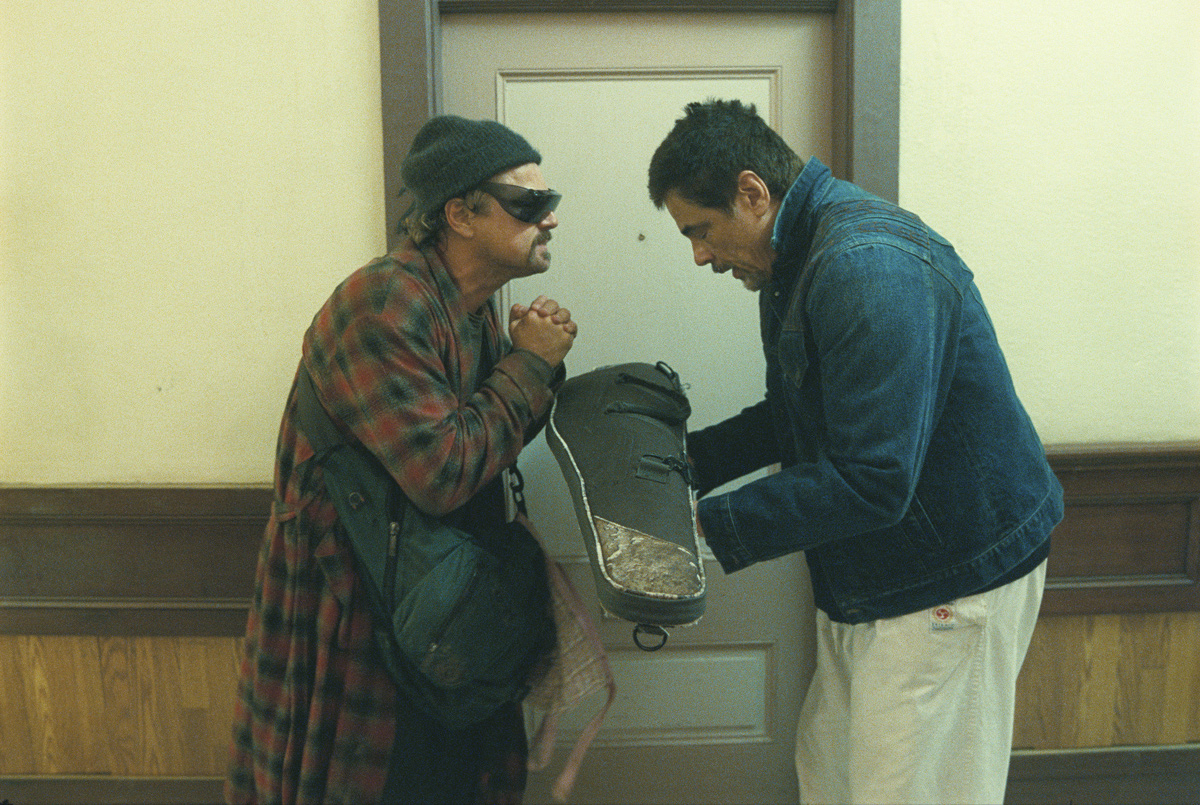
I’m starting with the top spot this year, if only because this year’s top spot is so obvious. One Battle After Another is just near-perfect in my mind, the culmination of an already-brilliant career for Paul Thomas Anderson and on the short list of best movies of the 21st century already.
I try to ignore dopey fan chatter and art-as-political-football discussions as much as possible, but my God, this one seemed to generate moronic arguments and awards nominations in parallel. In depicting a group of Weathermen-like radical revolutionaries, the French 75, as both risible and righteous, Paul Thomas Anderson’s adaptation of Thomas Pynchon’s novel, Vineland, is perfectly situated to attract dopey takes from both right and left. (“Paul Thomas Anderson’s decision to avoid depicting the political turmoil of the past ten years but to romanticize Sixties political violence in his new film One Battle After Another is a cowardly artistic choice,” wrote Armond White in his semi-neutered National Review incarnation).
I’m sure there’s a leftist, “the French 75 weren’t cool enough” take out there, and a liberal “the racial language used by fascists was uncalled for,” to go with White’s “the French 75 were too cool!” one, but I’m not going to Google it.
For one thing, as great as it is, One Battle After Another doesn’t seem all that thematically challenging. It seems to be making a more heartfelt, straightforward point than a lot of PTA movies do, in fact, which is part of why I like it so much. One distinction that all the swipes at it seem to ignore is that isn’t set in contemporary America. It offers plenty of analogues for it, but it’s not a perfect one-to-one comparison. The French 75 aren’t exactly the Weathermen or the Black Panthers, and the Christmas Adventurers (Hail St. Nick!) aren’t exactly the John Birch society, COINTELpro, Hoover’s FBI, the Skull and Bones, or whatever. Anderson (who is adapting a 1990 novel set in 1984 in 2025) makes this kind of fudging work because he tends to add specificity to differentiate where so many other storytellers would generalize.
In any case, how righteous or villainous the French 75 are seems sort of beside the point. What Anderson is doing, in my mind, is pointing out that resisting authoritarianism isn’t always easy, it isn’t always the “cool” thing to do (though it sometimes is), and your allies aren’t always going to be people who are smart, likeable, doing what they do for the right reasons, or even reliable when you need them most. They might be hopelessly naive or delusional, they might even flip and name names when the chips are down, because humans are fallible and blackmail works. Ghetto Pat/Bob’s goodness, like the goodness of most of OBAA’s central characters, is not without considerable baggage. Sometimes resistance feels pointless, sometimes it feels self-defeating and silly. It’s okay to laugh at them as much as we laugh at Steven J. Lockjaw; they’re funny! What makes the story rousing is that when Bob and Sensei Sergio St. Carlos are faced with the stark choice to care about their fellow humans or not, they choose the former. (They opt for socialism over barbarism, you might say).
“We got a little Latino Harriet Tubman situation going on at my place,” Del Toro deadpans. “All legit, from the heart, no cash.”
Movies take so long to make that it’s kind of insane and a miracle that one of One Battle After Another’s central scenes, eerily predicting the present, is an ICE-like raid on ostensibly liberal town (“a sanctuary city crawling with wet and stinkies,” in Lockjaw’s words). That, to me, is the heart of One Battle After Another: Sergio St. Carlos enjoying a few small Modelos and bowing before his tatami mats while doing his best to protect his neighbors from a gang of militarized thugs. It’s not necessarily the most tactical decision, the best political strategy, the best “praxis”; it’s just the most straightforwardly human response in that moment.
The shot of Bob, in his ridiculous Big Lebowski outfit, shrieking “Viva la revolución!” at Sergio, who wordlessly gives Bob the Black Power fist before disappearing into his homemade tunnel is maybe the most Wes Anderson shot of PTA’s career (in a good way). (Better than anything in The Phoenician Scheme, in my mind, but I’d rather not throw stones).

It makes me want to laugh and cry all at once, and that’s sort of the movie in a nutshell.
Meanwhile, I have to think that the only reason Sean Penn didn’t win best supporting actor at the Golden Globes (which went to Stellan Skarsgard) or the Critic’s Choice Awards (Jacob Elordi) was that he was nominated alongside Del Toro in both, splitting the One Battle After Another vote. I imagine that won’t be the case at the Oscars [UPDATE from the present: oops! It is exactly the same case!] (which would be a shame in some ways, since Del Toro’s performance is absolutely incredible in its own right) and Penn will get the award that so many of us expect him to.
It’s a testament to Penn’s all-timer of a performance that so many want this to happen despite not liking Sean Penn much as a person. Separating the art from the artist has rarely been so easy. While we’re at it, why not DiCaprio for best actor? I mean, I know he already has one, but c’mon, he did the Mexican whistle and everything.
Now that it’s on HBO, I threw on One Battle After Another late the other night, assuming that since I’d already seen it, it would be an easy thing to watch a bit of before falling asleep. Yet, as has happened with Goodfellas and Casino when I’ve happened upon them on cable so many times over the years, I ended up watching the whole damned thing; it’s just that captivating.
2. Sinners (original review)
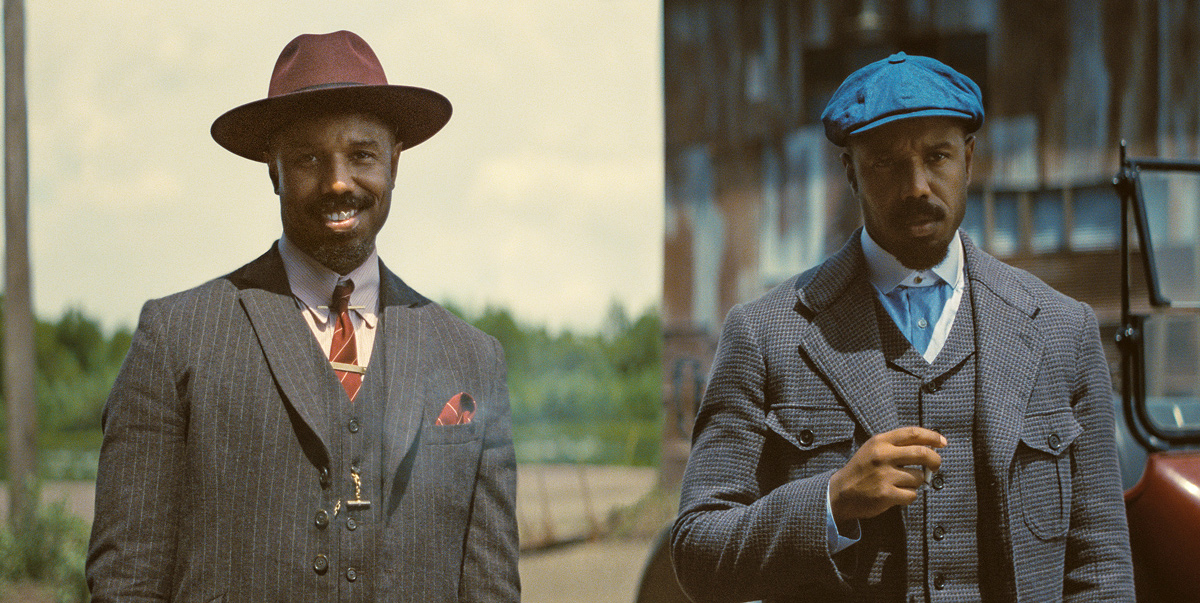
I went to see Sinners cold, and so for an entire hour I just figured I was watching a sumptuously costumed sorta-musical about sexy people throwing a party, and was perfectly content to do so. When it revealed itself as a goddamned vampire movie, I was wary at first. That didn’t feel like what I’d signed up for. And yet, it kind of only got better from there. There are the kinds of movies that hook you, you’re in them, you’re onboard; and then there’s Sinners, where you often have no idea where it’s taking you but it’s so damned beautiful that you’re willing to just go along for the ride.
Ryan Coogler, freed from the Marvel and IP yoke (as the director of Black Panther and Creed, cashing out on his indie hit Fruitvale Station) puts so many things in the blender that Sinners comes off entirely original: the historical revisionism of Tarantino, the “elevated horror” trappings of Jordan Peele, the identical twin conceit of Legends and The Deuce, all wrapped up in what feels like a mash-up of O Brother Where Art Thou from a black perspective meets from Dusk Till Dawn. And he still saved room for multiple cunnilingus scenes. God bless him.
There are a handful of moments in Sinners where I can imagine, if I was the studio exec, reading them in the script and trying to talk Coogler out of it. Hey, man, are you sure you really want to put this magical realist montage recounting the entire history of African diaspora music from Yoruba tribesmen to Sly Stone, in the middle of your Mississippi Delta vampire movie? Are you sure you want to name the twins “Smoke” and “Stack?” Honestly it seems like a big risk and movie totally works without it…
Then you see the finished scene, and the execution is so good that wondering whether it was in good taste to include in the first place becomes a moot issue. Sinners is like that, the ultimate “just stand back and let him cook” movie.
Every actor and every scene in this movie just looks so damn good that you can just sit back and let whoever’s onscreen just solo for a while. (Another commonality between all the movies on this list is that, content aside, they all look really good). Would Sinners be better if I could differentiate between Michael B. Jordan’s twin characters? Uh… maybe? Who cares? It’s a movie about seduction that seduces. I guess that’s sort of what I mean by “movie magic.” There’s such obvious joy in Sinners’ creation that it tends to overshadow the usual considerations of story, message, and metaphor. It is what it is; over-interpretation only cheapens it.
That being said, Sinners is meaty enough that it seems able to withstand a close read if you want to do one. Coogler has a rare knack for including odd little details and vignettes and footnotes that he’s interested in without it feeling like he’s grinding the whole movie to a halt to include them, whether it’s ragtime music, the Delta Chinese, hoodoo, or the Great Migration. A great editor once told me “be into what you’re into,” and Coogler seems to embody that advice. Turns out he’s into vampires, blues music, and eating pussy. Great for him, we’re all the better for it.
3. Caught Stealing (original review)
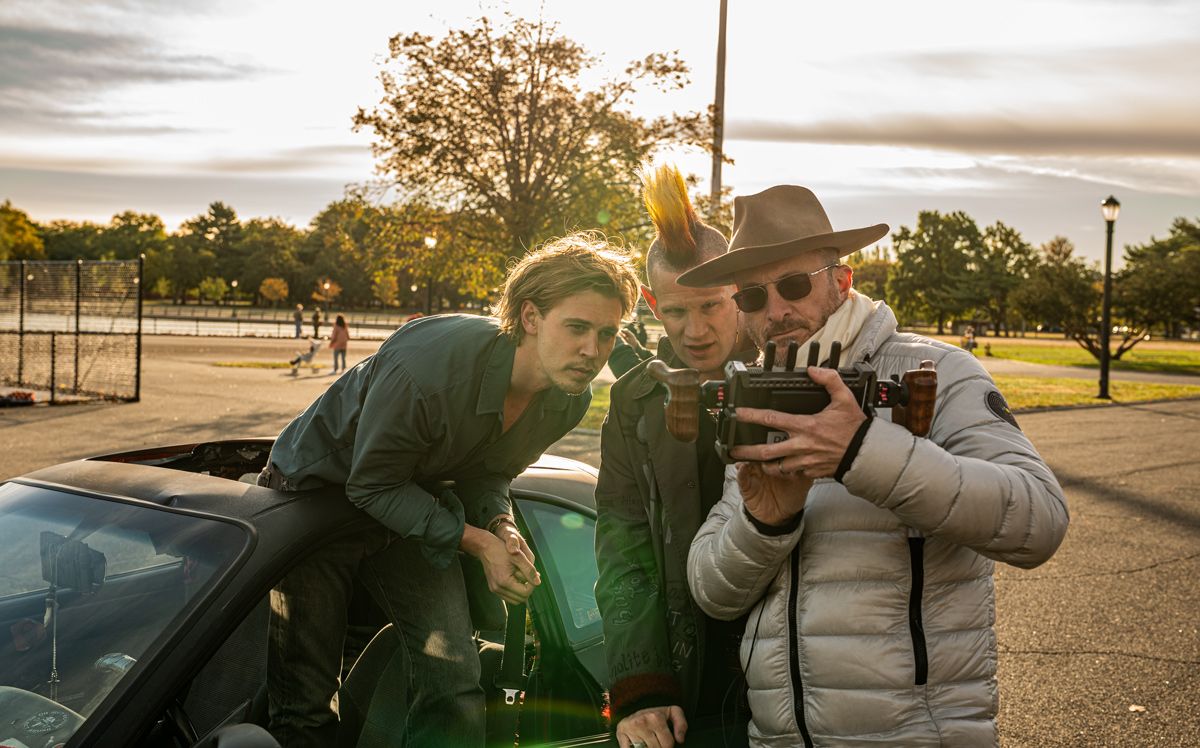
Speaking of movie magic, we had Caught Stealing, a balls-to-the-wall homage to Y2K-era caper movies directed by the King of White Elephants Darren Aronofsky, that somehow felt like exactly what the doctor ordered in 2025. Caught Stealing captured the look and feel of 1998 East Village New York so well that you could practically smell the stale beer, grounding us beautifully in time and place for an unabashedly pulpy potboiler that would’ve worked just as well in any era.
Even more so than Sinners—which was a thrilling movie first, though it offered plenty of embedded social commentary—Caught Stealing to me felt like a wild time for the sake of wild times, a Guy Ritchie-style movie better than any Guy Ritchie movie (apologies for this controversial yet entirely correct take!). Aside from that, it was just gorgeous on a shot-by-shot basis, a long-focus, neon-lit wild goose chase through 1998 New York. Did it help that the main character was from the San Joaquin Valley, obsessed with Barry Bonds, and that he signed off almost every conversation with his mom with “Go Giants?” Perhaps. That mom, incidentally, was played by Laura Dern, who, with turns in Caught Stealing, Jay Kelly, and Is This Thing On? this year seems to be taking up Nicole Kidman’s mantle of “I will die if I stop appearing in every show and movie.”
Most of Caught Stealing’s negative reviews or mixed reviews seemed to turn on the decision to kill off a major character just when the chemistry with the protagonist was heating up. In some ways, yes, that character was more interesting than Austin Butler’s. Yet while I understand being sad that a sad thing happened in the movie, it struck me as a bold choice, entirely in keeping with the theme of a wild ride that keeps you guessing until the end. Liev Schrieber and Vincent D’Onofrio as ruthless, Hasidic momma’s boy gangsters? Yes, please. And double yes to Carol Kane playing the mother.
I still don’t know whether Austin Butler is a great actor or a mid one who is fun to look at it, but I’m also not sure the distinction matters that much. Caught Stealing was my quickest rewatch of the year.
I’ve said this before, but between Benicio Del Toro’s ‘91 Nissan Sentra in OBAA and Matt Smith’s early 90s Toyota Celica in Caught Stealing, boxy Japanese cars from the early 90s deserve some kind of award. (No word on whether Jello Biafra is still selling his ‘89 Celica).
4. Eddington (original review)

If Caught Stealing illustrated movie magic, an exciting movie about the excitement of movies, Eddington was the other end of the spectrum: Ari Aster’s valiant effort to explore the last thing anyone wanted to talk or think about: the pandemic. You hear “pandemic movie” and just think “NOPE”, but maybe that’s just me remembering Locked Down.
No one wants to talk about the pandemic (including me), but it’s also sort of ground zero for our present psychosis, so it seems like someone should, and I for one am thankful that Ari Aster seemed to be the only guy raising his hand.
Eddington and Bugonia are kissing cousins, in my mind—both dealing with the fracturing of consensus reality, both imagining that at least one kooky conspiracy theory is actually real in the final act (Lizard People for Bugonia, Antifa Super Soldiers for Eddington), both starring a grunged out Emma Stone (how did they get her eyelashes all ginger like that?? bring back featurettes!).
I enjoy Bugonia, but I give the edge to Eddington. Aster just seems able to perceive a broader spectrum of specifically American psychoses than just about anyone, and he weaves them into an incredible tapestry in Eddington. Constitutional sheriffs, crypto bros, Facebook aunts, technocratic sleazeboys, wellness cults: the sheer variety of “Guys” in Eddington alone justifies its existence. And I would still watch Joaquin Phoenix paint a house. In fact I’m kicking myself for not thinking of this in my Oscar’s article (which in fairness, I had to rush out because it was new news), but as long as we’re talking about Best Actor, where the hell was Joaquin Phoenix? I get the feeling Joaquin Phoenix has that Olivia Colman thing, where we sort of take his greatness as a given just to keep from nominating him every year and to keep things interesting.
Certainly Aster lost a lot of people in the last bit of the movie, during the Antifa Super Soldiers sequence, which was certainly a choice. I would defend it on the grounds that: 1. it’s thematically fitting for the reality of a movie about the fracturing of reality to begin to fracture; for a movie about psychosis to get a bit psychotic, and 2. it was surprising and funny. Also, the final sequence, with a vegetative Joaquin Phoenix hanging dong, was damn near as funny as Sean Penn being loaded into the cremator in One Battle After Another. We love to see our authoritarians being stripped naked and physically degraded, don’t we, folks? Not hard to see the collective Freudian wish fulfillment underpinning that one, I celebrate the entire catalogue.
5. Marty Supreme (original review)
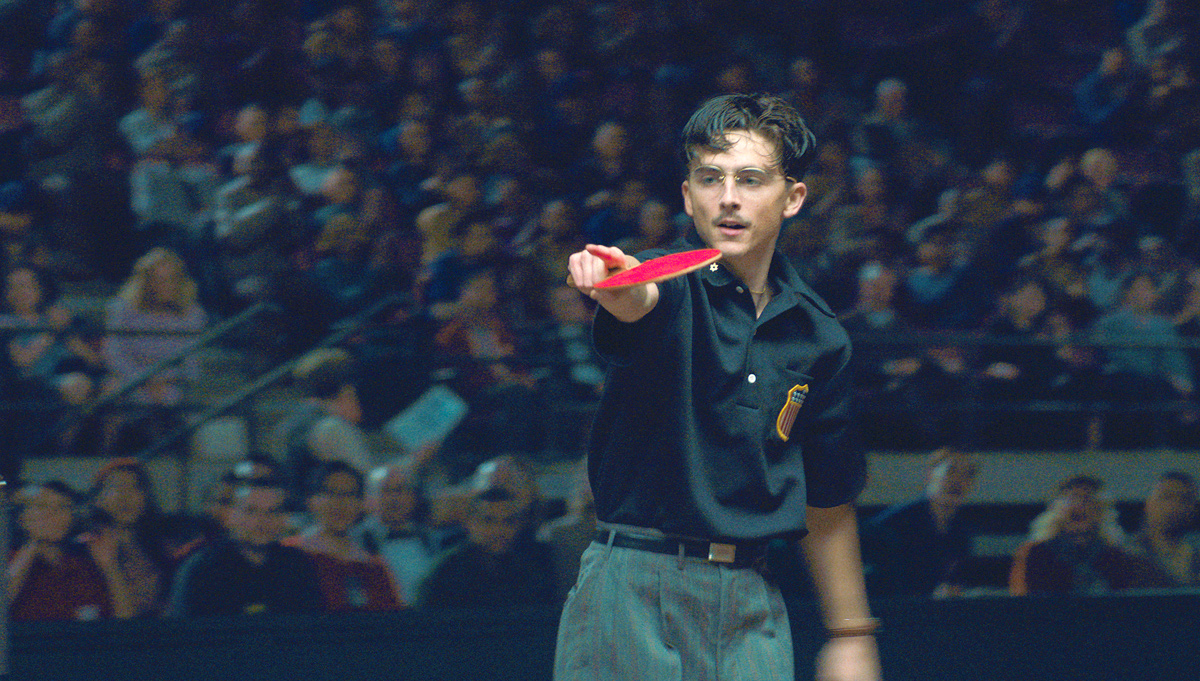
Timothee Chalamet assumed his final form as an obnoxious, annoying little shit with pockmarks and a unibrow in Josh Safdie’s strangely uplifting ode to New York Grime. I was thoroughly entertained watching this little weasel (or, to borrow the real Marty Reisman’s actual nickname, The Needle) talk himself out of situations that he’d talked himself into in the first place.
If so many of this year’s other great films were about the fracturing of consensus reality, Marty Supreme seems to me, at its heart, to be about precarity. In a world where it feels like we’re all living on the razor’s edge, Safdie gives us an ironically feel-good story about the ultimate tightrope walker. Marty’s existence is always precarious, usually of his own making, and he never lets that keep him from doing exactly what he wants to do, consequences and Mr. Wonderful be damned.
Speaking of Mr. Wonderful: Josh Safdie put a reality show dickhead who’d never acted before in his movie on a whim and it ended up being one of the most memorable performances of the film. Sinners keeps winning casting awards (and in a vacuum, I would never argue against that movie’s incredible casting), but how do you not give it to the movie that gave us Mr. Wonderful, the Golden-Voiced Hobo, Tyler the Creator, an unrecognizable Penn Jillette playing a Dust Bowl redneck, and Abel Ferrara as an evil, heartbroken mafioso dog lover? Josh Safdie is going to put Jon Taffer in a movie some day and it’s going to be a amazing.
Marty Supreme’s final credits needle drop of Tears for Fears is tied with One Battle After Another’s final credits needle drop of “American Girl” for overused needle drops that absolutely should not work but nearly brought me to tears anyway.
What a picture.
6. The Secret Agent
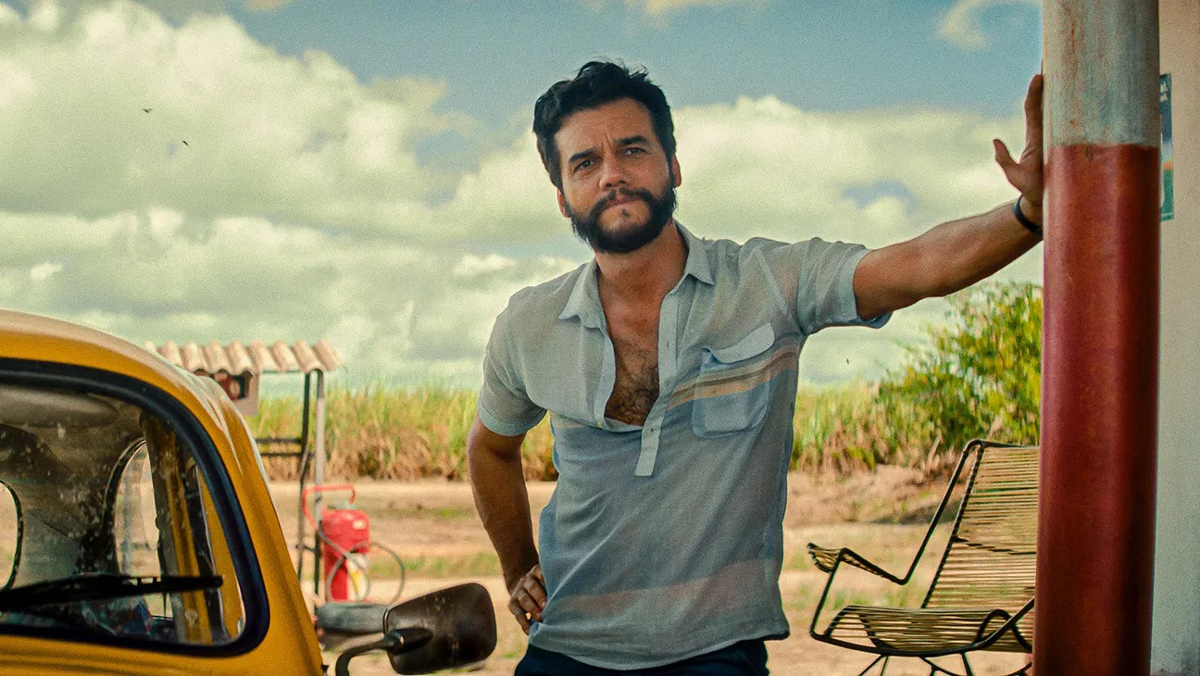
2024 gave us I’m Still Here, an acclaimed Brazilian film about that country’s military dictatorship that won lots of awards (including best actress at the Oscars), though it didn’t quite translate for me. I don’t know if I was missing too much cultural nuance to appreciate it, or if it was just that movies where the dominant emotion is numb grief always fall flat for me. Anyway, I mention it because this year we have another Brazilian movie about the dictatorship and this one totally landed.
I still feel like I’m missing some important political and cultural context that would’ve been immediately apparent to any Brazilian, but this time around those nuances were only the difference between great and an all-timer. If anyone wants to do an annotated version of The Secret Agent, send that screener my way. I can trade you for a One Battle After Another screener annotated for non-Californians.
Anyway, it’s obvious that there’s a lot more going on in The Secret Agent than I can understand, but scratching the surface was rewarding in any case. Wagner Moura plays the protagonist, a professor and widower who has fallen afoul of the dictatorship (for what we eventually learn are typically arbitrary reasons), fleeing the city for a sort of dissident commune apartment complex in Recife. The first scene takes place at a dusty rural gas station where a corpse is rotting just athwart the pumps because, it being Carnaval weekend, the police and other authorities are too busy to come take care of it.
There’s a lot going in The Secret Agent that I probably missed, but I recognized the vibe: a sort of Charles Portis/Catch 22-esque dark farce. If I’m Still Here was about the banality of fascism, The Secret Agent was about its cruel absurdities—all while looking infuriatingly beautiful for basically its entire run time. We need to force Wagner Moura to get fat for another role, this svelte version is entirely too handsome.
The Secret Agent makes a great complement to Andor S2 and One Battle After Another, a film about how resisting authoritarianism isn’t about always knowing the right answer or having perfect tactics, it’s actually a pretty straightforward choice between recognizing a shared humanity or not. As a whole, The Secret Agent is weird, it’s warty, it’s long; there’s lengthy interlude about shark attacks and a magical realist sequence about a disembodied leg becoming homophobic. But I didn’t have to entirely “get” it in order to know that I wouldn’t soon forget it.
