Marty Supreme's Honey Story is Real (and Other Notes)
Plus, Marty Supreme's ending explained, and what was the deal with that vampire speech?
Welcome to The #Content Report, a newsletter by Vince Mancini. I’ve been writing about movies, culture, and food since the late aughts. Now I’m delivering it straight to you, with none of the autoplay videos, takeover ads, or chumboxes of the ad-ruined internet. Support my work and help me bring back the cool internet by subscribing, sharing, commenting, and keeping it real.
—
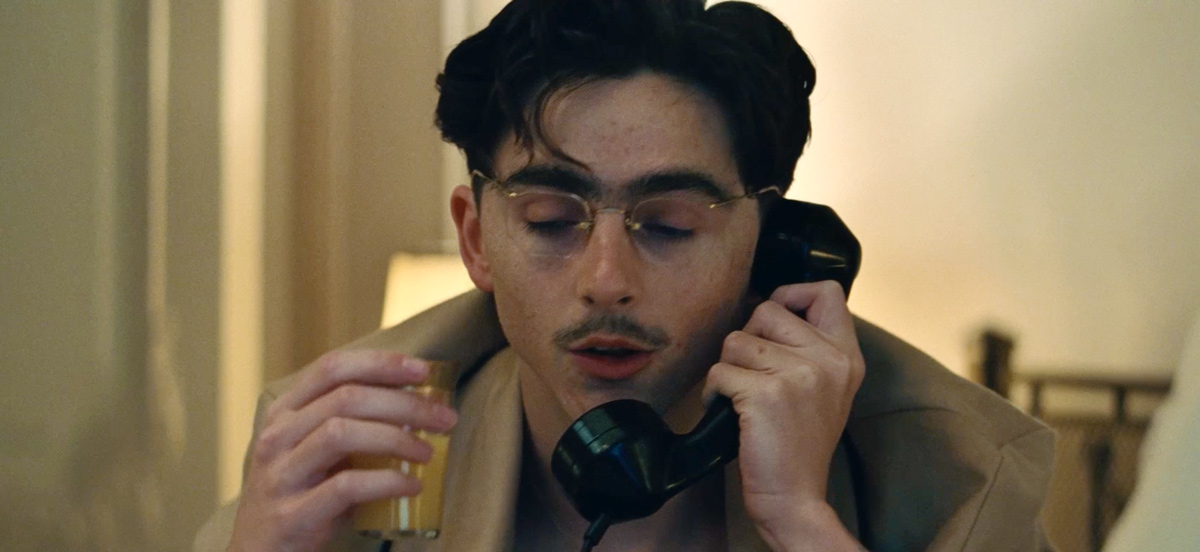
Aside from being a great time, Marty Supreme is a rare thing: a fictionalized version of a true story that leaves out some of the best parts without ever making you feel like you miss them. I wanted to know more about Marty Reisman, the basis for Timotheé Chalameét’s Marty Mauser, but I didn’t feel like I needed to know more about Marty Reisman in order to enjoy the movie.
Nonetheless, a couple of recent articles, including one by Julien Levy over at Rolling Stone and another by David Davis at Defector, recount the no-less-entertaining real-life story of Marty Reisman. They’re a nice supplement to the film, with some insights into the real Reisman, who died in 2012.
One aspect of the story that Marty Supreme only vaguely touched upon, for instance, was the transformation table tennis was undergoing at the time—which ended up coinciding with Reisman’s fall from world title contender to sideshow act. What happened? Apparently, it all had to do with the paddles.
In 1952 the World Championships were held in Mumbai (then Bombay). In a preliminary match, Marty was bracketed against a Japanese player who had never competed internationally. “Hiroji Satoh [was ranked] number nine in Japan at the time,” Hodges explains. “He was a good player, but nowhere close to the level of Reisman.” […]
Up until this point, players used “hardbat” rackets; wood with a thin layer of dimpled rubber or sandpaper. Satoh was permitted the use of “a weapon” that Reisman wrote “would make table tennis a different sport.” Coated in three-quarter-inch foam rubber, Satoh’s racket — now the standard in professional play — enabled previously unachievable degrees of speed and control. “Sometimes [the ball] floated like a knuckleball,” Reisman wrote. “On other occasions the spin was overpowering.” The foam also silenced Satoh’s hits, rendering his opponents “deaf mute in a game that required dialogue.” Satoh had only to make contact with the ball and Reisman’s strength became an Achilles heel. “I was throwing lethal punches and hitting myself in the face.”
Another, even more in-depth piece by David Davis over at Defector describes the change in greater detail:
Marty and every other top-ranked player had instinctively learned to anticipate the flight of the ball—its spin, velocity, and trajectory—in part by the sound it made coming off the paddle. Twick-tock, twick-tock, twickety-tock. But Satoh’s foam muted the reverb, rendering worthless the innate skills that Marty, [Dick] Miles, and others had gleaned over thousands of hours of hardbat exchanges.
“Like Willie Mays taking off at the crack of the bat,” Reisman explained, “we were all conditioned to react to the sound of the racket hitting the ball. But with Satoh that was impossible.”
Reisman faced Satoh in a preliminary round. He managed to win the first game before losing the match in four. “He gave me that little bow; a nice man, I thought, but oh how I hated him.”
Miles was less charitable. “This abused, apologetic homunculus who had wrecked the game in 10 days was never seen again in international play,” he wrote.
Reisman tracked down Satoh in Japan to revenge his ignominious defeat. But he couldn’t or, rather, wouldn’t adjust to this alien form and eschewed the “fraud and deception” of the sponge paddle with only rare exceptions. His obstinacy puzzled friends and opponents alike, leaving them to wonder why he didn’t at least try to change. Marty refused to be swayed.
An anguished Miles wrote that the newfangled serve-and-volley affair of speed and spin “reduced a sport to a game,” and lamented that table tennis was no longer attractive to the TV networks. Their disapproval did little to halt the sponge revolution amid rule changes that standardized the thickness of the sponge on the paddles and, eventually, led to the introduction of the “sandwich rubber” (sponge covered with ordinary rubber). “Overnight, former champions were has-beens,” noted Reisman, arguing that sponge was a boon for manufacturers because the rubber wears out quickly and has to be replaced frequently.
This brash American was suddenly undone by a quiet Japanese thanks to a game that had gone suddenly silent? Can you believe Safdie left this as mere background? Any other filmmaker would’ve snatched that ready-made metaphor and made positively sure that you could smell what he was cooking.
It’s a credit to Safdie and Ronald Bronstein that they instead allow this context to exist as mere background, confident that their take on the story is more important than the story itself. Probably a lesson in that.
Nevertheless, reading this has turned me into a hardbat purist and I will not rest until people know the truth about how BIG RUBBER conspired to RUIN PING PONG 30 years before I was even born. We used to be a proper country.
Meanwhile, the other great revelation from the Rolling Stone piece is that my favorite scene from the movie, possibly my favorite movie scene of the year, was real. Or at least, was based on a real-life anecdote. And yes, I’m talking about the honey scene.
Here’s how I described it in my review:
In one scene, which really doesn’t spoil anything to describe, Milton Rockwell [played by Kevin O’Leary] notices the tattoo on the forearm of Marty’s friend and competitor, a Czech named Kletzki, played by Géza Röhrig. “You were in the camps?” Milton asks.
“He was,” Marty answers for him, and prods, “Kletzki, why don’t you tell him a story?”
The story Kletzki relates is how he survived the camps, by learning how to defuse bombs. The Nazis would send him deep into the forest, so that in case he failed at his task the explosion wouldn’t hurt anyone but him. One day, Kletzki says, a bee buzzed by him, so he followed it back to the hive. Then he used a cigarette to smoke out all the bees, took their honey and spread it all over his body. Then he smuggled the honey back into the barracks under his clothes, and let the other prisoners lick the honey off of him for sustenance.
So that’s the movie version. Here’s the real anecdote, excerpted from the Rolling Stone piece:
One legendary player Reisman held in especially high regard was Alex Ehrlich, a Polish Jew who, prior to competing in London, had been a member of the French Resistance. Imprisoned at Auschwitz, on several different occasions, Ehrlich was spared the gas chamber when — each time — a Nazi recognized him as a table tennis champion.
This part wasn’t in the movie, since it arguably detracts from the honey story, but I think it says a lot about the importance of table tennis at the time that concentration camp guards, who didn’t even have television at the time, would repeatedly recognize a table tennis champion.
Forced to defuse bombs in the nearby woods, Ehrlich once happened upon a honeycomb. “He smeared the honey all over his body,” wrote Reisman. “When he got back, the inmates licked the honey off his body for nourishment.” To Reisman, Table Tennis players are, simply, a different breed of athlete. “Remembering [meeting these players], I find it amazing how many people around the game of table tennis have stayed with it their entire lives. It is a game that infects the bloodstream,” he wrote. “Ehrlich was tortured by the Nazis, but he never let his scars show.”
Does it make Marty Supreme’s honey story better to know that it’s real? Probably, though it was always a weird enough story that you could sense that it wasn’t entirely fictional. Though of course, it’s also possible that Reisman made up the story, or embellished upon what he heard, since he is the original source for it. I think that’s part of what makes it such a great scene in Marty Supreme—that it feels like you’re hearing a tall tale from a skilled raconteur and trying to work out which parts are real. That’s sort of the movie, and Marty’s character, in a nutshell.
It’s also notable that to Reisman, the honeycomb anecdote was a story about table tennis players being tough; while to Josh Safdie and Ronald Bronstein, it seems meant to convey Reisman’s brilliance as a storyteller and his constant scheming. There’s also another level, as pointed out by someone on Bluesky, in which the story underlines the way the war exists mostly as mere fodder for a good story to Marty, the weaselly opportunist, in contrast to the more subdued Kletski and Kendo, who seem to have been genuinely changed by their wartime experiences. And then you could read all three as stand-ins for the post-war experiences in their respective countries.
Or, you could just be like “whoa, did you see when those guyus licked the honey off that guy? That was crazy, huh.”
A close read is fun, but not required.
Okay, But What Was the Deal with the Ending?
Since the film came out, there’s been a lot of chatter about Marty Supreme’s ending (bigger spoilers to follow, obviously).
If I’m being honest, it never occurred to me while I was watching it that it was the kind of movie that might require an explainer. For me it’s almost a requirement of great art that it have an element or two that resist a straightforward interpretation. So when things got a little wobbly I felt no compunction to try to square the circle.
Rewatching Marty Supreme this past week, I guess I can understand a little better why some people might’ve left the theater scratching their heads. In the penultimate scene, Marty Mauser is engaged in his climactic showdown with Koto Endo (the Hiroji Satoh character), at an exhibition organized by the pen tycoon Milton Rockwell, played by Kevin O’Leary from Shark Tank. The match is only supposed to be an exhibition, though Marty wants to do it for real, seeing it as possibly his only opportunity to avenge his previous loss to Endo. Rockwell wants him to lose, since the whole point was to put on a show and endear themselves to the Japanese market, not embarrass their national hero.
Rockwell sees what Marty is obviously up to, and takes him aside to warn Marty against it, delivering what has come to be known as “The Vampire Speech.”
“I was born in 1601. I’m a vampire. I’ve been around forever. I’ve met many Marty Mausers over the centuries. Some of them crossed me, some of them weren’t straight. They weren’t honest. And those are the ones that are still here. You go out and win that game, you’re gonna be here forever too. And you’ll never be happy.”
In retrospect, I suppose it’s somewhat understandable that a lot of people heard that speech and went, “Uh, what the fuck?” Indeed, what was the deal with the vampire speech has been a major thrust in a lot of the negative reviews for Marty Supreme.
Well, at least according to O’Leary, the whole vampire thing was his idea.
