Awards Season Digest 2: The Mastermind, Is This Thing On?, Song Sung Blue, and The Rental Family
Would you prefer a Kelly Reichardt, a Bradley Cooper stand-up movie, a Neil Diamond jukebox non-biopic, or Lost in Translation starring Brendan Fraser?
Welcome to The #Content Report, a newsletter by Vince Mancini. I’ve been writing about movies, culture, and food since the late aughts. Now I’m delivering it straight to you, with none of the autoplay videos, takeover ads, or chumboxes of the ad-ruined internet. Support my work and help me bring back the cool internet by subscribing, sharing, commenting, and keeping it real.
—
God bless them, it seems that the studios are all dropping their end-of-the-year releases in one big deluge again, when the average person can’t possibly see them all, even though this past week was a veritable movie desert, with nothing much going on but the disastrous Ella McCay. This week brings us (*Sean Connery voice*) Avatar: Fire and Ash, and then it’s a whole bunch of Christmas Day releases.
And so, here’s another attempt to get through a few more Awards Movies with abbreviated reviews, to help with all your holiday movie decision-making. If you can only see one movie this awards season, so far my vote is Marty Supreme. But more on that in a future newsletter.
—
Is This Thing On? (limited theatrical, starting 12/19, from Searchlight)
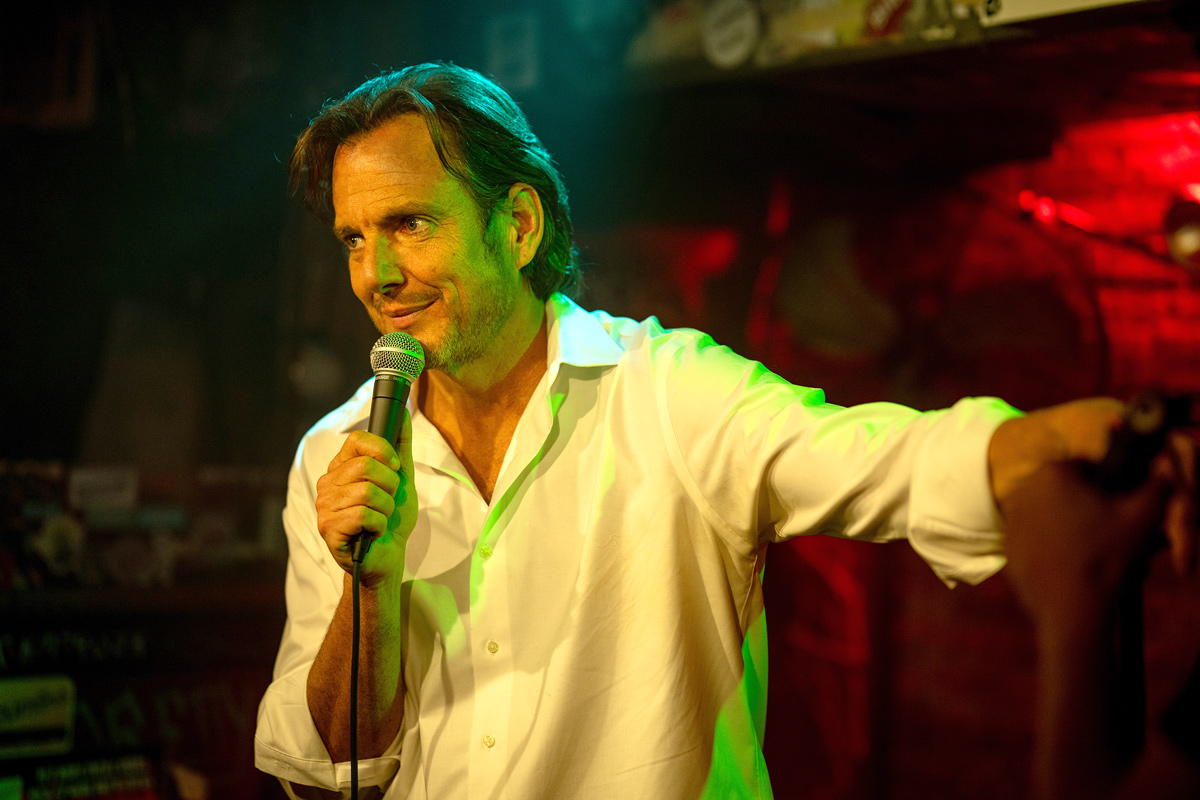
Bradley Cooper directs Will Arnett in this based-on-a-true-story tale of a sad dad who gets his mojo back during a divorce by becoming a stand-up comedian. Is Bradley Cooper (A Star is Born, Maestro) a good director? I still don’t know. On the one hand, he takes this concept, which feels very much like it’s going to be a gender-swapped Marvelous Mrs. Maisel with all the usual comedy clichés, and turns in mostly a pretty good movie, light and sweet and mostly just surprising enough. On the other, Is This Thing On?’s biggest drawback is that it mostly lacks any visual style, an area in which you’d expect a director’s hand to be most recognizable.
Arnett plays Alex Novak, a dull dad content to merely go through the motions of suburban life, which isn’t enough for his ex-elite athlete wife Tess, played by Laura Dern, who respectfully requests an amicable divorce in one of the first scenes. Alex, looking for something to do with himself, returns to one of his favorite city bars, discovering that the only way to avoid paying a cover charge is to put himself on the list for the open mic. He goes onstage, discovers a safe space for complaining about his wife (“women, they be shoppin’, am I right fellas? This guy knows what I’m talkin’ about…”) and the the movie jumps off from there. Why don’t they build the whole plane out of black boxes??
My first thought watching Is This Thing On? was that Cooper, Arnett, and Dern simply aren’t Jewish enough for this seemingly very Jewish story about a tight-knit family in the NYC suburbs who love discussing their problems at length and eventually find solace telling Borscht Belty jokes to strangers. As it turns out, Is This Thing On? was actually based on the real-life story of a British guy, John Bishop, a salesman who, like Alex Novak, initially took to stand up during a divorce in order to avoid a cover charge at his local pub. Hard to say whether it’s the Maisel influence or the setting swap that accounts for Is This Thing On’s slightly uncanny non-Jewishness, but it’s much easier for me to imagine a British guy trying stand-up to avoid paying a cover charge at a pub than it is to imagine an American goy in New York City doing the same, for whatever reason.
Obviously I bring my own former long-time stand-up comedy dabbler baggage to Is This Thing On?, or to any show or movie about stand-up comedy. Cooper’s version (scripted by Cooper, Arnett, and Mark Chappell) has some of the clichés of the genre, like an audience that’s far more generous than any open mic audience I’ve personally encountered, but it also avoids some of the major pitfalls.
It resists depicting comedy as some act of radical truth telling, for instance, rather than a parlor trick (Novak’s act seems to improve as he gets less vulnerable, for instance). Best of all, the focus is much more on Alex finding this new, weird community of misfits that he enjoys being part of than him honing his act or finding his comedic voice. Sadness is not Alex Novak’s comedic super power, thank God. Instead he merely joins a loose affiliation of oddball losers and fame whores and people with crippling personality disorders who find mutual satisfaction in making each other laugh for whatever reason. That has mostly been my experience. Is This Thing On?’s sweetness comes off entirely genuine in that way.
It’s still frustrating that Cooper never deems it important to tell us what Alex Novak actually does for a living or to compose many shots that don’t involve just jamming the camera up Will Arnette’s left nostril. Aside from it being less interesting to look at, you can kind of tell when a filmmaker thinks every detail and bit of context is important to his story, vs. when they’re trying to deliberately blur and elide enough information to make it non-specific enough to pass as believable (in order to swap a story’s setting from the UK to the US, say). Laura Dern, who’s in everything this year, probably also needed a jogging double if she was going to play a former professional volleyball player (otherwise she’s fantastic, as always). Actors’ jogging form so often betrays them.
Is This Thing On? isn’t quite a “mixed bag,” more just a good movie that maybe could’ve been a great one. My last note was “mid, but good.” Certainly it’s a step up from having to listen to Carey Mulligan’s most impeccable mid-Atlantic accent for two hours.
Song Sung Blue (Christmas Day theatrical release, Focus Features)

I’m torn on whether Song Sung Blue’s concept is more interesting than the actual movie, which isn’t necessarily a criticism, since the concept is delightfully insane. Song Sung Blue is essentially a jukebox musical, made with the full rights and permissions to the entire Neil Diamond catalogue, only it’s not actually about the life of Neil Diamond. Though it is a biopic, about a husband-and-wife Neil Diamond tribute act called Lightning and Thunder, played by Hugh Jackman and Kate Hudson. Hustle and Flow’s Craig Brewer writes and directs, adapting a documentary of the same name from 2008.
That Song Sung Blue feels like light family entertainment for the majority of its runtime belies all the crazy shit that actually happened to its two main characters. I’d rather not spoil it, since a musical biopic with major story beats that actually happened but that you don’t see coming is a rare thing indeed. Suffice it to say, this semi-struggling musical impersonator act manages to hit all the standard Behind the Music story beats—unlikely rise, pinnacle of success, major adversity, addiction, fall from grace, rock bottom, against-all-odds comeback—in as dramatic a fashion as anyone actually depicted on Behind the Music, all without its subjects ever being especially famous. Though they did open for Pearl Jam at one point. At the very least, the world needs to know that Eddie Vedder, at the peak of his mid 90s fame, once joined a husband-and-wife Neil Diamond tribute act onstage to sing “Forever in Blue Jeans” in front of an audience of rabid Peal Jam fans.
As crazy as its story beats are, Song Sung Blue does at times border on a tedious, extended musical montage, so determined it seems to be to get through every damned hit and B-side in the entire Neil Diamond catalogue, sometimes three or four times. There’s also a child actor in there who is distinctly not good (along with Ella Anderson, who is good, but looks uncannily like a young Amanda Bynes). Another big drawback, at least for me, is Hugh Jackman’s singing voice. It’s obviously powerful, precise, and well-practiced, but for me his excessive theatrical vibrato always sounds at least vaguely like a cat being strangled. It’s probably a “me” thing, where certain voices, no matter how well they hit the notes, are just nails on a chalkboard (hearing Adele, Alicia Keys, or Adam Levine will ruin my entire day). Jackman, always a winning actor, is probably at his least obnoxious singing Neil Diamond songs, but his voice is still his voice.
Conversely, Kate Hudson sounds fantastic as Patsy Cline impersonator-turned-Neil-Diamond-duet-artist Claire Sardina, apparently singing all of her own material. I could listen to Kate Hudson sing Patsy Cline songs all day, which is not a thing I ever expected to type on at least three different levels. Along with the revelation that she can really sing, Hudson also does her best acting work in years.
Song Sung Blue certainly hits my upper limit of hearing Hugh Jackman singing Neil Diamond songs, and part of me is compelled to express the plainly futile desire that, I dunno, maybe this Neil Diamond jukebox musical could’ve had fewer Neil Diamond sing alongs? A very strange hill to die on, certainly, but all the cheeky songs do distract somewhat from the wild story.
Of course, Song Sung Blue is also a movie that is, at its heart, about the pleasures of surrendering to kitsch (complete with Jim Belushi and Fisher Stevens in supporting roles). Above all it’s true to itself. My two biggest takeaways were that it was insanely cool for Neil Diamond to license his music for this, rather than some self-serving biopic vanity project; and that I really need to watch the Greg Kohs documentary upon which it was based.
The Mastermind (MUBI)

Kelly Reichardt is something of a darling among the film festival crowd and A24-tote bag-owning set, and every few years she puts out a new movie that I get talked into seeing during FYC season. Her last one was 2019’s First Cow, a sort of 19th century hobo bromance food porn that was very much on the cusp of being great. Promising enough, at least, to imagine Reichardt’s latest improving on the formula and justifying the rave reviews this time around.
The Mastermind stars Josh O’Connor, the hot rodent man from Challengers, as the titular mastermind of an art museum heist in 1970s Massachusetts. All of that sounded good, and seemed intriguing at first, but I guess I wasn’t banking on a full 15 minutes of screen time being devoted to a guy carrying some paintings up a ladder. First he looks at the rafters. Then he looks around for a ladder. Then he positions the ladder next to the rafters. Then he realizes it’s not quite right, so he climbs down and repositions the ladder. Then he gets the paintings. Then he wraps the paintings in a sheet. Then he realizes the sheet isn’t quite right and repositions the paintings inside it. Then he starts to carry the paintings up the ladder…
Spoiler alert: He puts the paintings in the rafters.
The Mastermind is very plainly an homage to the tense, quiet thrillers of the 1970s, like The Conversation and Friends of Eddie Coyle (Anthony Bourdain’s favorite, Quentin Tarantino says it’s overrated—bro fight!), process-obsessed narratives where part of the appeal is simply watching characters go determinedly about their business (see also: The Pickpocket). Yet the reason those kinds of movies work, when they work (and I think I’m more on Tarantino’s side here than Bourdain’s, unfortunately) is that the quiet, determined actions are always imbued with the potential energy of something dangerous or terrible happening. In a word, suspense.
There’s a little of that in the early going of The Mastermind, mainly during the actual heist part, but for one thing, we rarely know as much about what’s happening on screen as The Mastermind’s characters do (sort of the opposite of Hitchcock’s version of suspense), and for another, Reichardt quickly trains us not to expect any payoffs. What is this, a ladder to nowhere?!
There’s a scene in Wonder Boys, in which novelist/professor Michael Douglas’s worshipful grad student, played by Katie Holmes, is critiquing his long-delayed comeback novel that only she has been allowed to read so far. “Grady,” she says. “You know how in class you’re always telling us that writers make choices? And even though your book is really beautiful, I mean, amazingly beautiful, it’s... it’s at times... it’s... very detailed. You know, with the genealogies of everyone’s horses, and the dental records, and so on. And... I could be wrong, but it sort of reads in places like you didn’t make any choices.”
In the same way, either Kelly Reichardt isn’t making choices in The Mastermind, or the ones she does make are timid, a sort of cinematic “jazz is about the notes you’re not playing” approach.
The movie finally threatens to become interesting when Josh O’Connor’s character becomes a fugitive and tries to hide out at a farm house with an old friend, played by John Magaro, and his wife, played by Gaby Hoffman. The Magaro and Hoffman characters bring a welcome kookiness to The Mastermind (passing the Levity Test!), such that it’s easy to imagine the superior movie in which they were introduced much earlier, and the characters allowed to, I dunno, actually interact with one another some more.
Instead, just when things are heating up, Mastermind’s extremely-chill-for-a-fugitive protagonist decides on his own to try something else that involves walking or driving or staring determinedly at things all by himself. I can’t really remember, I’d kinda zoned out by that point. That tends to happen when you know beyond a shadow of a doubt that no payoff is forthcoming.
Just as First Cow was a very nice, gentle movie about two platonic male friends who just wanted to do nice things that I ultimately didn’t quite buy, The Mastermind is a kinder, gentler 1970s crime-and-mafia movie set in some alternate universe New England where no one says slurs or beats the shit out of each other or has sex (which we don’t necessarily have to see in order to enjoy, but we do have to be able to imagine that it’s possible). And in both there’s very little in terms of character arcs. Here are some guys. They do stuff. Cinematic influences.
In the end The Mastermind feels very NPR-coded, the kind of movie in which no one does or says anything too naughty or nothing distasteful or overly schlocky happens and the biggest thrill is the kind of joke that doesn’t make you laugh out loud but rather smile in your head a little, which is much better than a car chase for a certain kind of repressed intellectual.
One of The Mastermind’s glowing reviews says that it “nails the folly of male entitlement,” which I suppose is true in the sense that an attitude of blasé privilege predominates and an entitled man is its main subject. Only everyone else in the film seems pretty blasé as well. And why wouldn’t you be blasé in a fictional universe where nothing much happens?
Rental Family (supposedly in theaters 11/21, from Searchlight, but good luck finding it)