An Updated Ranking of Paul Thomas Anderson Films
The release of 'One Battle After Another' means it's time to update the list of the best PTA films.
Welcome to The #Content Report, a newsletter by Vince Mancini. I’ve been writing about movies, culture, and food since the late aughts. Now I’m delivering it straight to you, with none of the autoplay videos, takeover ads, or chumboxes of the ad-ruined internet. Support my work and help me bring back the cool internet by subscribing, sharing, commenting, and keeping it real.
—
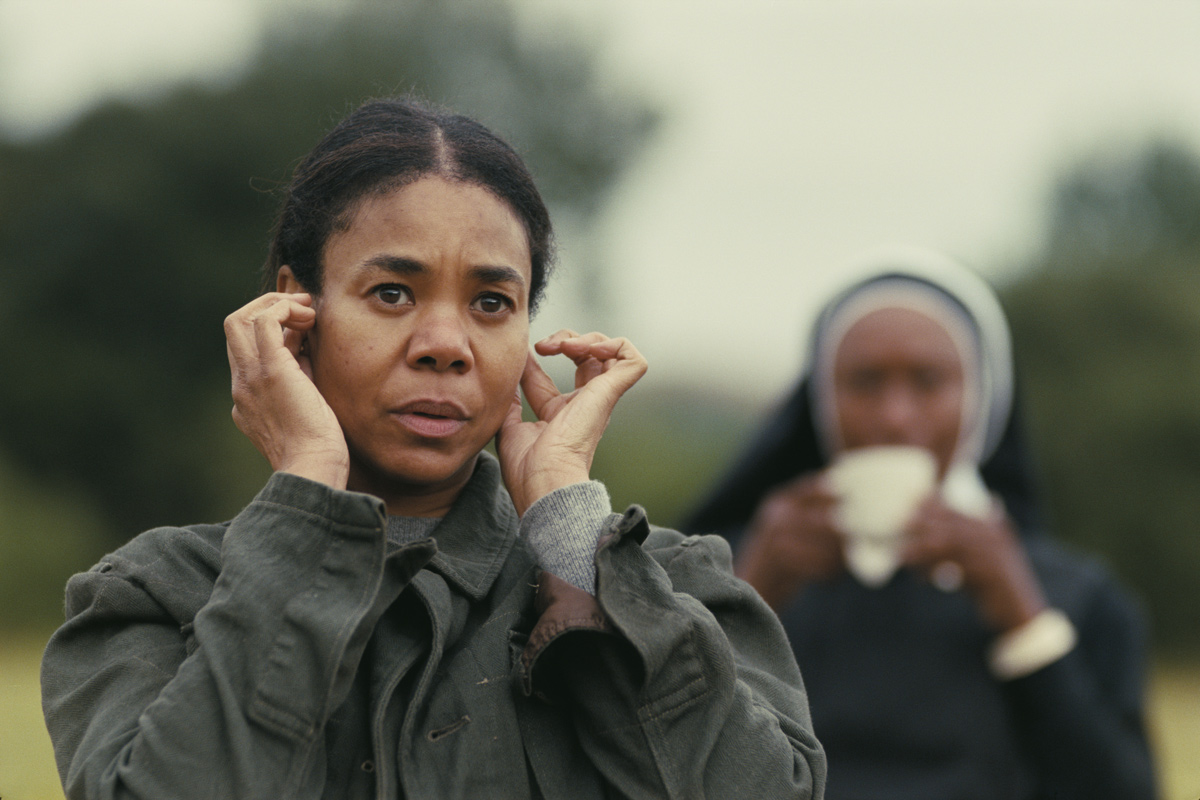
Rankings. Do we have to? Isn’t it, like, offensive to the art to act like it can be reduced, quantified, and compared like so many stacks of chips at a poker table? Didn’t we leave that kind of engagement bait behind with the death of ad-supported media?
Yes, but also: shut up. We all kinda hate rankings, and yet we all invariably read them and make our own in our heads as we do. It must be human nature. Why deny it? Ranking art is like loving true crime shows: my brain tells me I’m above it but my actions assure me that I’m not.
Now then: Paul Thomas Anderson. His career, beginning with Boogie Nights (I hadn’t seen Hard Eight yet at that point) almost perfectly spans the length of time I’ve been “a movie-head.” Does that make me uniquely susceptible to his movies in particular? We can never entirely discount the right place/right time effect, but PTA is far from the only director working who started his career during the latter 90s indie movie boom, and he’s the only one of them who made One Battle After Another.
Even with a truly strong crop of films this year, One Battle After Another made a pretty strong case for PTA as our greatest living American director. I’ve done a lot of these director rankings, and the PTA canon (sorry for the acronym, it’s just so much easier to type) is about as close to “no skips” as it gets. His ten features (not counting his 54-minute Johnny Greenwood documentary, Junun) are all killer, no filler. Even more so than that, his films aren’t just “important,” “life-affirming,” “challenging—any of the usual adjectives thrown about when discussing acclaimed directors. His movies are, almost to a film, very funny, and beautiful to look at without exception. Like Scorsese, PTA makes the kinds of movies that you catch a glimpse of and then find yourself watching even if you didn’t to. He’s a great director who makes funny films that are fun to watch: imagine that.
It’s arguably not a complicated formula, but PTA is rare, maybe singular, in his ability to combine sex, urgency, hilarity, and visual mastery. And he seems to get funnier with age.
To watch all of a director’s movies is to get a sense of their tics and pet obsessions. Tarantino loves Elvis, the swingin’ sixties, B-movies, and blood spray. Wes Anderson loves center frames, boys in uniform, people reading lists, and gruff father figures. The Coen Brothers love the frontier, arcane vernacular, screwball comedy, and folk music. And so forth. For PTA, that list looks something like 70s California and the aging counter-culture; hucksters; child actors, child performers and grown-up child performers; distant fathers and characters finding father figures who aren’t necessarily their fathers; and stunted characters with overbearing families. If I was better at charts, I’d make one.
Yet inasmuch as there are common themes, there’s rarely been a moment in a PTA film in which I thought, Oh boy, he’s going back to the well again. He arguably isn’t as adaptable as Aronofsky or as experimental as Steven Soderbergh, but he has a way of making even his most consistent obsessions fit the material. Rewatching PTA movies is about as much fun as you can have researching a list.
10. Magnolia (1999)
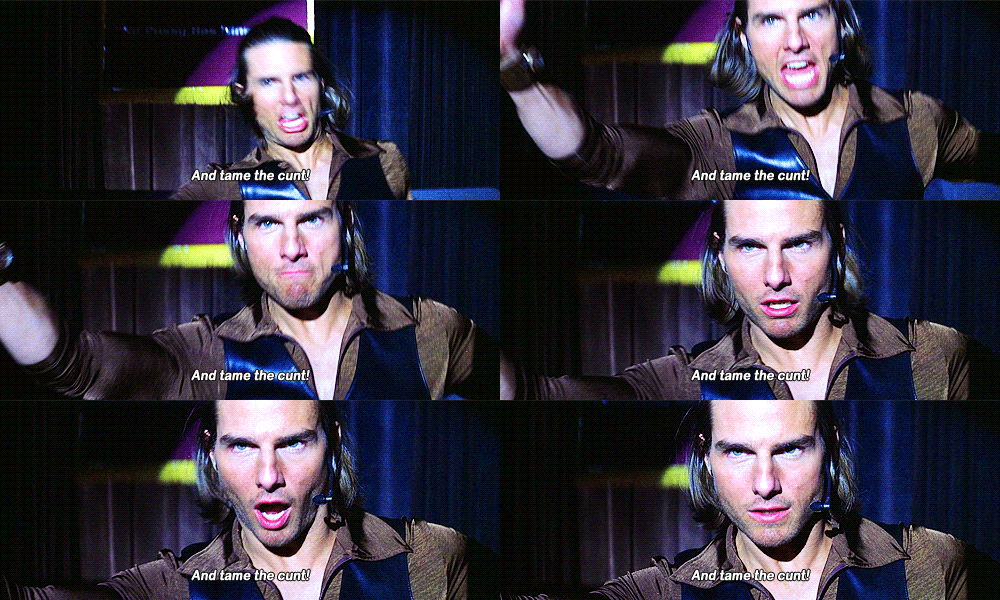
As I wrote in my One Battle After Another review, Magnolia is the PTA film that had me arguing the Tarantino side of the PTA vs. Tarantino debate my obnoxious film friends would have back in the Y2K era. I’d like to think my tastes have matured since then, but even with the benefit of time, Magnolia is still my least favorite of the Anderson bunch. It feels like an outlier in the PTA oeuvre (pardon my Fronch) as the only overtly magical realist one. And yet oddly, its magical realist scenes are arguably the most memorable.
Magnolia is the interconnected tale of a handful of characters—some of whom are child prodigies and grown-up child prodigies, an early echo of Cooper Hoffman’s character in Licorice Pizza—all of whose lives are mostly sad and pathetic, bookended by some magical realist scenes on either end. The opening prologue takes the form of a montage, a handful of vignettes about stranger-than-fiction tales, including a scuba diver who gets scooped up by a fire plane (Patton Oswalt!), a man who gets killed during his suicide attempt, etc.
We fast forward to the present day for an interconnected tale of woe, concerning the dying host of a kids quiz show (Philip Baker Hall), his strung out daughter (Melora Walters), the awkward cop who likes her (John C. Reilly), a grown up quiz kid (William H. Macy), the dying producer of the show (Jason Robards), and the producer’s grown-up pick-up artist son, Frank TJ Mackie (Tom Cruise), among others. Someone on Wikipedia made this adorably dorky flow chart to explain how they’re all connected, which is beautiful, I think.
Frank TJ Mackie runs a dead heat with Collateral for Tom Cruise’s best performance and for me is the heart of the movie, nearly transcending all the navel gazing around it. PTA deserves some credit for basically predicting Andrew Tate. Frogs rain from the sky in Magnolia’s final chapter, justifying the truth-is-stranger-than-fiction devie from the prologue. Self-indulgent as it is as a narrative device, I love the frogs. PTA shoots them too beautifully not to. Magical realism rarely has such a well-developed sense of the absurd.
So much of Magnolia, frogs especially, feels like a Darren Aronofsky movie, and since Requiem for a Dream wouldn’t come out for another year, it’s hard to tell who was influencing whom. Probably it was just in the air, since Magnolia feels generally of a piece of with the sadboi-core of Y2K arthouse dramas, from Requiem (2000) to 21 Grams (2003) to Crash (2004) and Babel (2006). Meanwhile, the opening montage feels like it could’ve been directed by a less whimsical Wes Anderson.
It’s a credit to PTA that Magnolia is probably the best Y2K sadboi drama, but it is still a Y2K sadboi drama.
9. Hard Eight (1996)
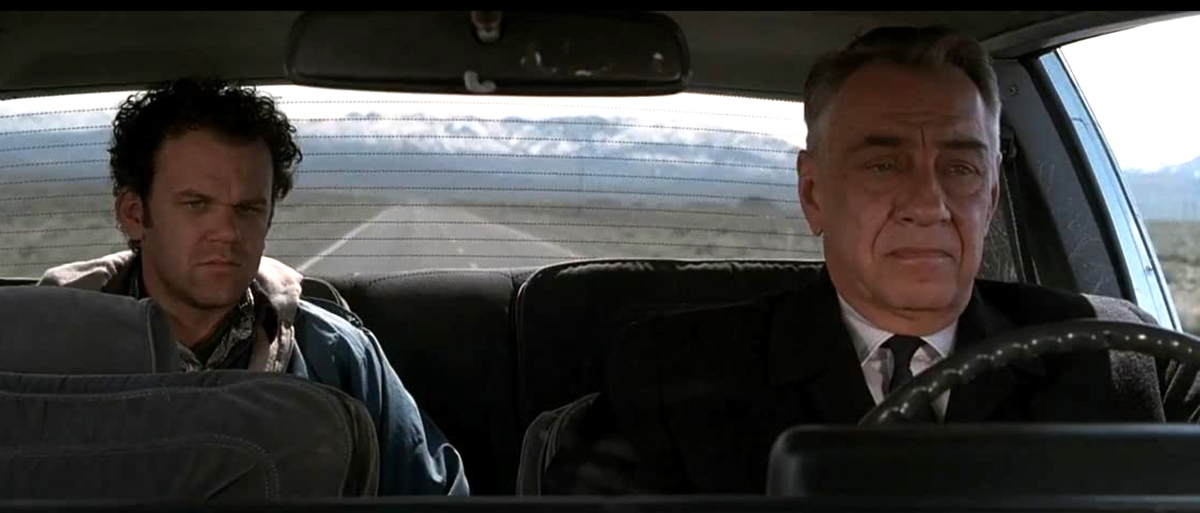
I’d probably file Hard Eight under “good for what it is,” which is a relatively low budgeted feature ($3 million, adapted from a PTA short) with just four main actors, a handful of locations, and hardly any music. Luckily, those four actors happen to be John C. Reilly, Philip Baker Hall, Gwyneth Paltrow, and Samuel L. Jackson.
Whereas so many future PTA characters feel like Freudian windows into his psyche, Hard Eight feels like it was built mostly out of stock archetypes. There’s an old hand who’s seen some shit (Philip Baker Hall), the hooker with a heart of gold (Gwyneth Paltrow), the angry young man without a father (John C. Reilly, and the predatory hustler (Samuel L. Jackson) — in a sort of film school conventional story about lost children looking for fathers and absent fathers looking for redemption. (Anderson’s own father was an actor and a locally-famous broadcaster)
Of course, even without a massive budget or any of the California’s halcyon days themes we’ve come to associate with him, PTA’s take on the 90s pulp indie is characteristically one of the best of its genre, and the relatively simple act of casting John C. Reilly in a lead role marked PTA as a visionary. John C. Reilly is on the short list of actors who can be hilarious in a 90-second sketch and pull off the dramatic lead in a weepie.
8. Phantom Thread (2017)
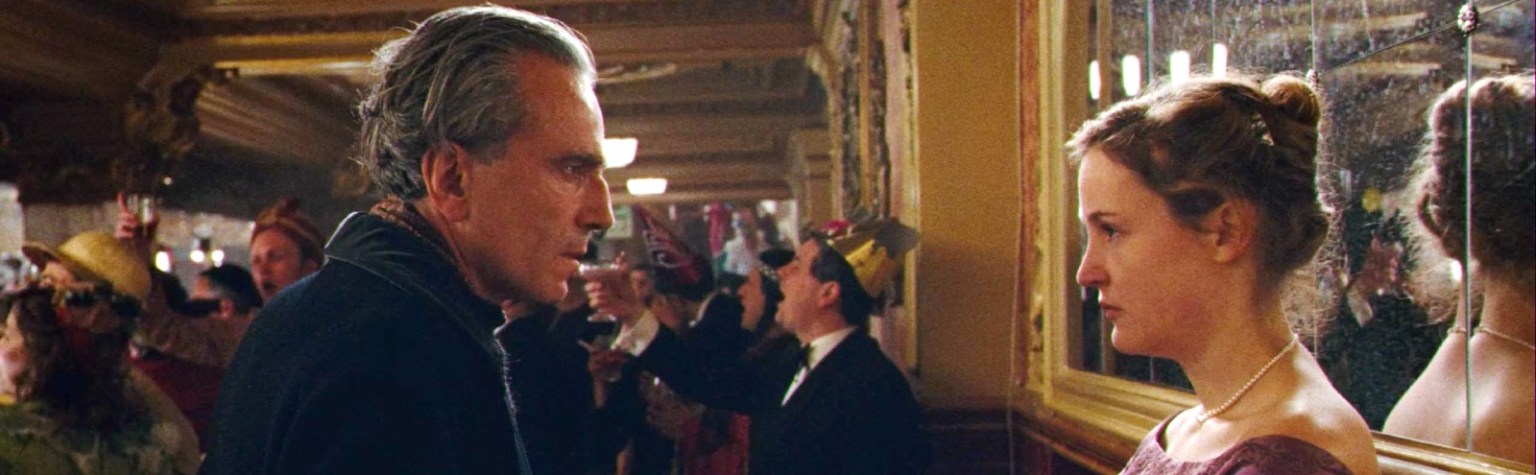
Is Phantom Thread PTA’s most-memed movie? I love its little moments as much as anyone else, from its operatic passive-aggression—the deafening scrape of a knife on toast—to the sensually shot scene of a Vicky Krieps preparing a mushroom-poisoned omelette. I don’t know that anyone has ever made the act of poisoning a spouse look so sexy. I could’ve watched an entire film just about the drunk rich woman who the fussy dress designer Reynolds Woodcock seems to hate.
Phantom Thread certainly proved that PTA could direct a restrained, refined, arthouse-conventional film about British high society, I’m just not convinced that its his ideal form. For as well as he writes and shoots them, it seems clear that PTA doesn’t quite understand repressed British homosexuals in nearly as varied and distinct a taxonomy as he does California’s lost and stunted children. It’s still fun, just… not as fun.
7. Punch Drunk Love (2002)
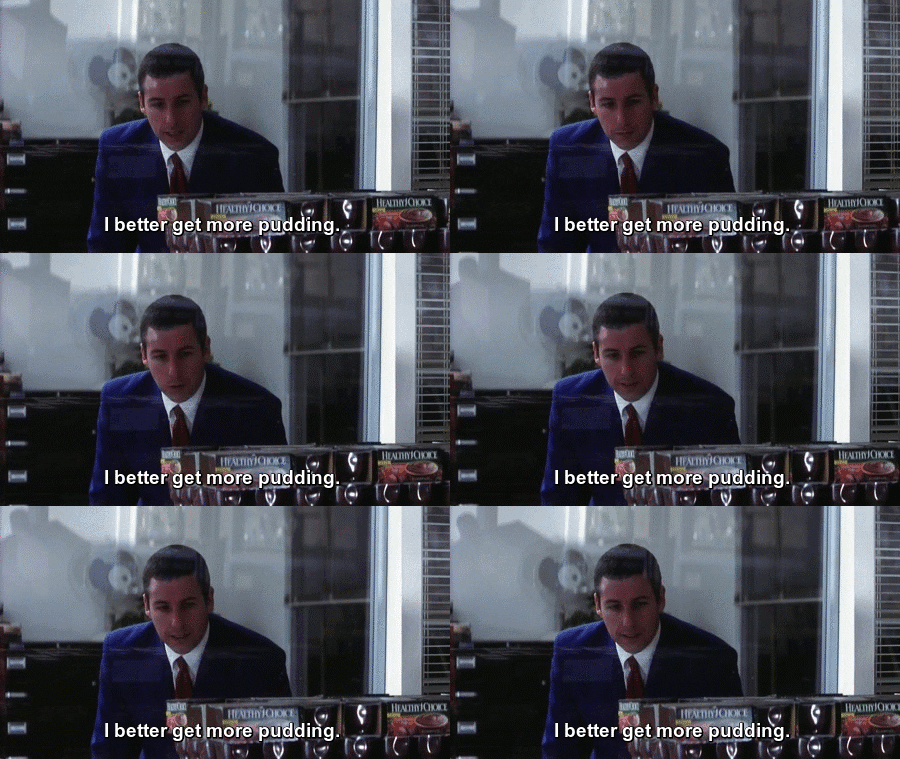
If PTA arguably helped usher in the era of early aughts sadboi core with Magnolia, it’s interesting to note that just as the trend was reaching maximum saturation, he was basically making Arthouse Waterboy. I say this as a high compliment. Not that Punch Drunk Love was entirely not sadboi core, but it was certainly a twist on the genre, more a punk comedy than an introspective piece.
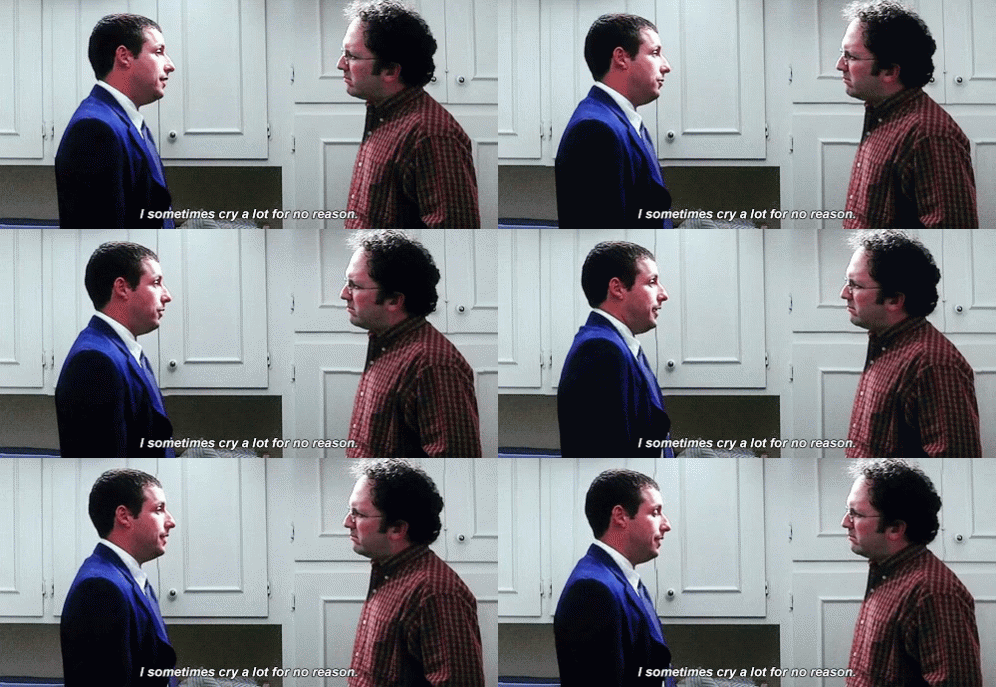
In Punch Drunk Love, Sandler plays Barry Egan, a stunted everyman whose impotent rage becomes his superpower, which he uses to save his family and get the girl—just like every Sandler movie ever. In that way, Punch Drunk Love is essentially just Paul Thomas Anderson’s take on an Adam Sandler movie, like a Michelin starred chef offering his riff on Animal Fries from In N Out (which I actually had once, it was incredible). Punch Drunk Love plays like both the id of other Adam Sandler movies, unadulterated by the demands of a multiplex comedy, and as a brilliant dissection of them. For me it’s also one of Sandler’s funniest performances, at least judged by sheer laugh volume.
For all the ways there are to compliment Paul Thomas Anderson, and we’re only four movies into this list and already into the portion of films I would describe as “flawless,” he perhaps doesn’t get enough credit for the sheer range of roles he cast Philip Seymour Hoffman to play. PSH’s sad horny gay guy in Boogie Nights (“I’m so stupid!”) and Schmell Ron Schmubbard in The Master are rightly probably the first two that come to mind, but don’t sleep on Hoffman in Punch Drunk Love. PTA let him scream at Adam Sandler like they were both in a contest to see who could go bigger without breaking character:
This was two years before Along Came Polly. Which maybe isn’t a great movie, but is an unforgettable Philip Seymour Hoffman performance. We had a lot of movies in which Hoffman played various flavors of “wormy little guy” before Punch Drunk Love, but PTA was arguably the first to let Hoffman go full-on big-dicking blowhard. The world was better knowing Hoffman had that gear.
6. Inherent Vice (2014)
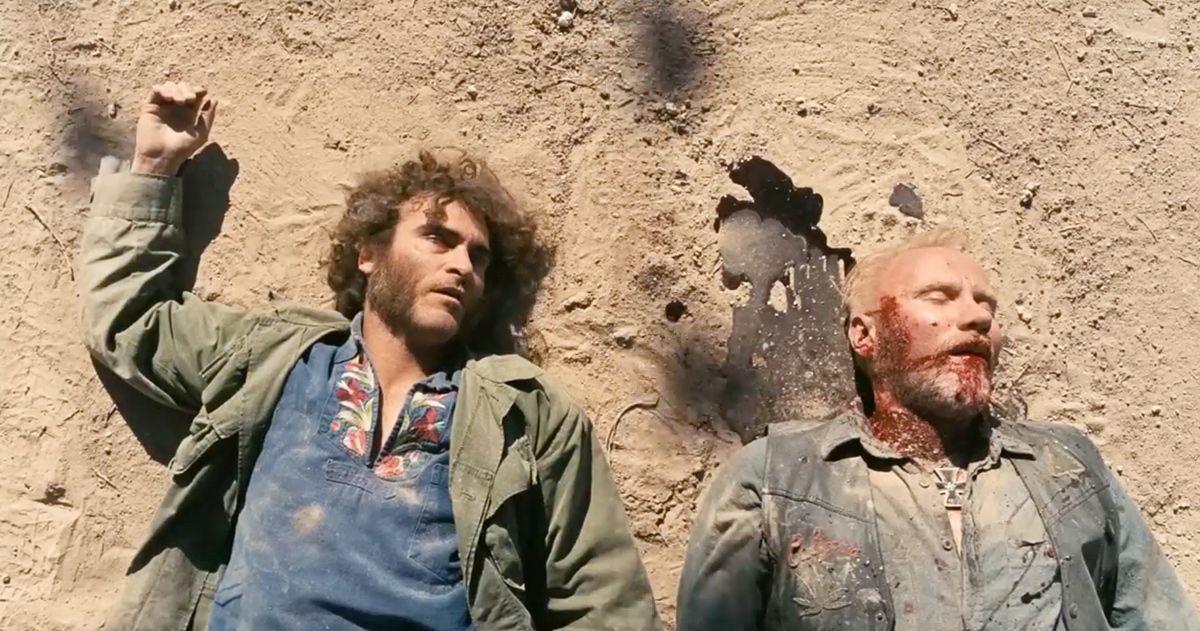
Inherent Vice is somehow hard to love and impossible not to love at the same time. It has three or four separate scenes that would make it worth watching even if everything else in it was terrible, but it’s also a deliberate shaggy dog story, chaotic by design, and feels like it wants to turn you as addled and paranoiac as its unreliable narrator, Joaquin Phoenix’s Doc Sportello.
It’s also probably the definitive work about 1970s, post-counter-cultural California, after it went from the-parents-are-away pool party to something approaching Lord of the Flies. The “pussy eater special” scene is an all-timer for many reasons, but part of what stands out about it is how cynically it depicts the hypersexualization of the time. It’s Free Love as ennui, Hong Chau playing a sexy girl selling cunnilingus like it’s a timeshare from the desk of a portable classroom in an abandoned used car lot. A more brutal skewering of the era may not exist.
If Eddington is a movie about the fracturing of consensus reality, Inherent Vice is an early harbinger, a 70s period piece about the fracturing of consensus morality.
It’s hard to think of a Hong Chau performance that didn’t make me want to stand up and cheer, but even in a filmography like hers, Inherent Vice stands out. And Inherent Vice is full of scenes like this.
Sean Penn probably deserves an Oscar this year, but it’s worth noting that he wasn’t the first guy to play a hilarious meathead in a PTA Pynchon adaptation.
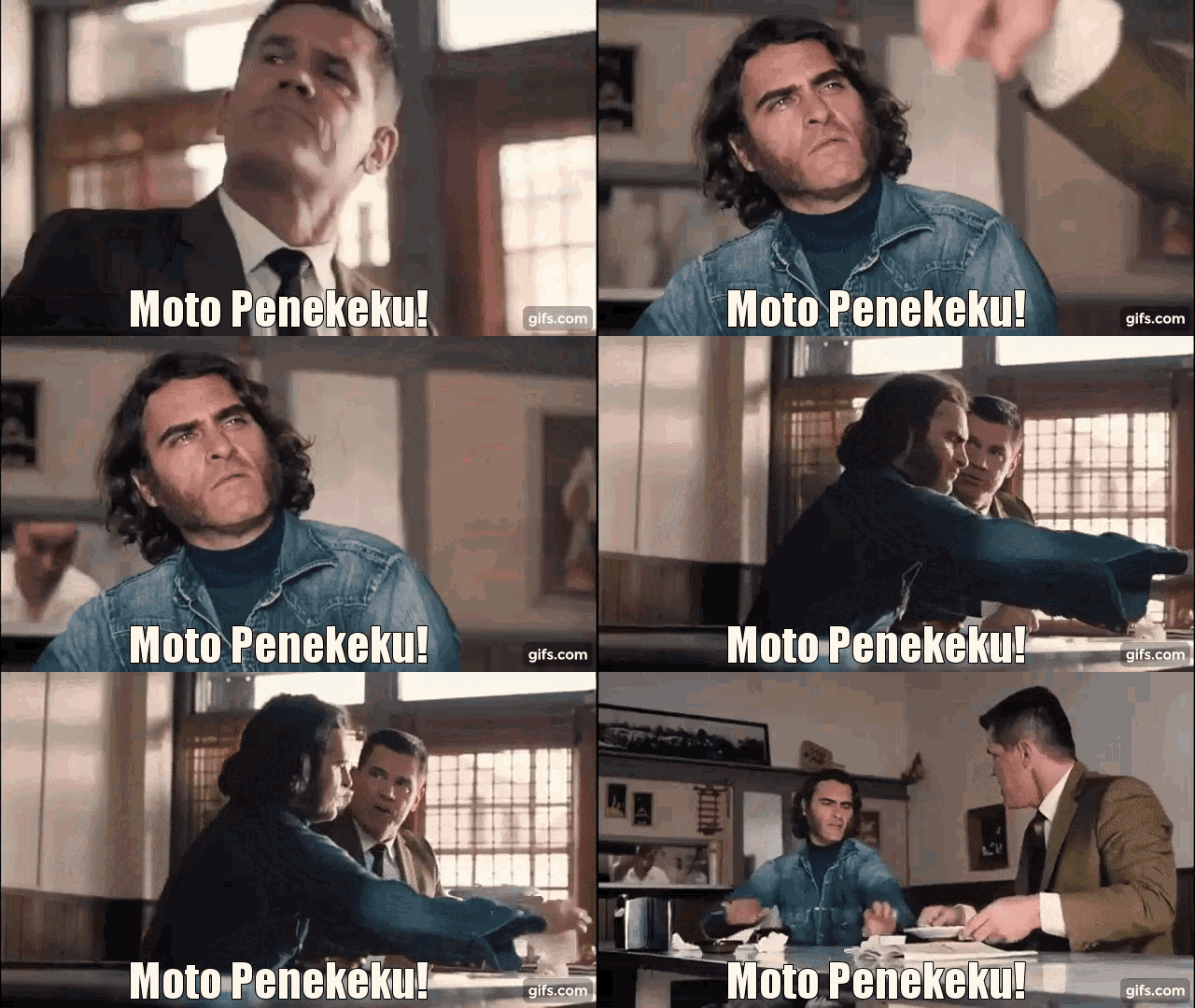
Between this and the much-maligned John Michael Higgins scene in Licorice Pizza, I think we can add “white guys poorly mimicking Japanese culture” (“weebs,” in internet parlance) to PTA’s list of obsessions alongside child performers, 70s California, and hucksters.
If anything, Inherent Vice seems true to Pynchon almost to a fault. The silly names start comin’ and they don’t stop comin—Shasta Fay Hepworth! Michael Z. Wolfman! Petunia Leeway! Dr. Buddy Tubeside!—and PTA milks them for every ounce of hilarity. But the sheer volume of them makes it exhausting at times, and all that cleverness occasionally edges into the smug. PTA was right to downplay some of the silly names in One Battle After Another—Del Toro’s “Sensei Sergio St. Carlos” is mostly only referred to as “Sensei,” for instance—and cut the smugness with a big, beating heart. The proximity censors that play complementary parts of a song when they’re near each other was all PTA’s invention (I think), and on paper, one of the syrupiest of Hollywood plot devices. But as Casablanca screenwriter Julius Epstein once said, “when corn works, there’s nothing better.”
Faults aside (which wouldn’t be nearly so obvious if PTA hadn’t himself made a better Pynchon adaptation), Inherent Vice is one of the sexiest, most beautiful movies ever made. That PTA accomplishes that in what is essentially a screwball satire makes it even more impressive.
4. The Master (2012)
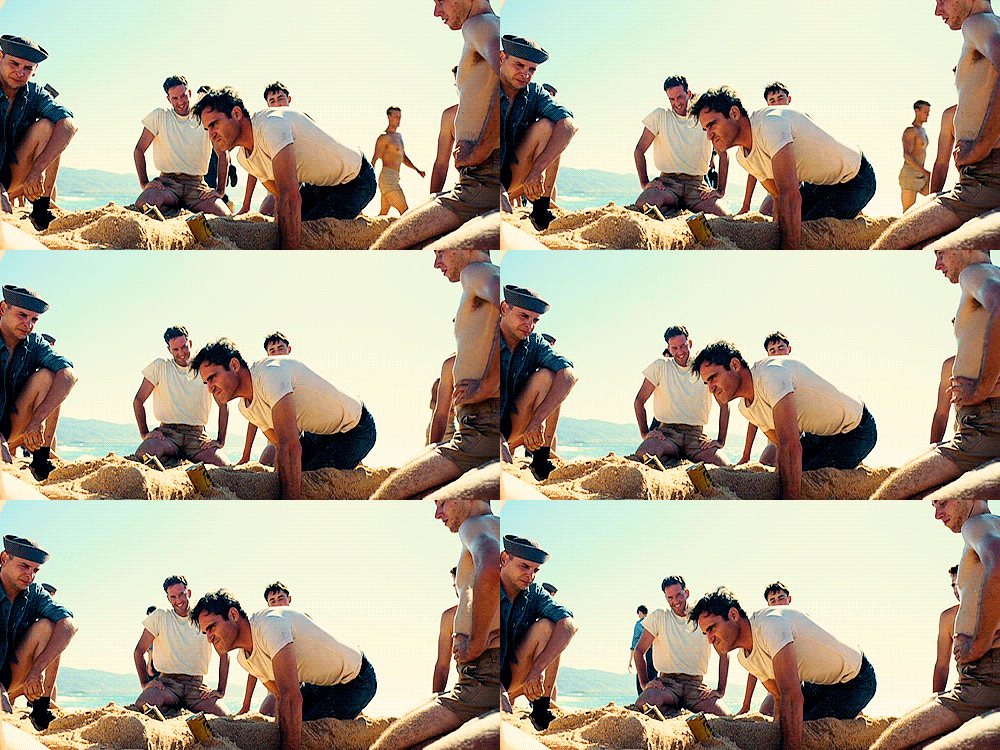
The Master is probably the most similar to Inherent Vice in the PTA catalogue, in that it’s also long, meditative, and meandering. You don’t know always know where it’s going, but I mostly didn’t care. I think I nodded off a few times the first time I saw it in theaters, but the whole thing has such a pleasant dream quality to it that I think it actually enhanced the experience (see also: Jiro Dreams of Sushi).
Philip Seymour Hoffman plays a fictionalized L. Ron Hubbard in one of his all-time greatest roles, with Amy Adams as one of his daughters and Joaquin Phoenix as his main acolyte. That he shot glorious, picturesque 70 mm landscapes of Joaquin Phoenix jacking off onto tide pools and fingerblasting sand castles feels like the PTA experience in a nutshell. It also makes brilliant use of Phoenix’s iconic misshapenness, his oddly stately asymmetry (which Ari Aster plays for full comedic effect in the dong-hanging interlude in Eddington).

?ref=the-content-report.ghost.io#/media/File:Magnolia_Character_Relationships.svg)