The Rock Gets Raw (Mostly), in the Accurate-to-a-Fault 'Smashing Machine'
Dwayne Johnson is mesmerizing as Mark Kerr in Benny Safdie's studiously factual biopic.
Welcome to The #Content Report, a newsletter by Vince Mancini. I’ve been writing about movies, culture, and food since the late aughts. Now I’m delivering it straight to you, with none of the autoplay videos, takeover ads, or chumboxes of the ad-ruined internet. Support my work and help me bring back the cool internet by subscribing, sharing, commenting, and keeping it real.
—
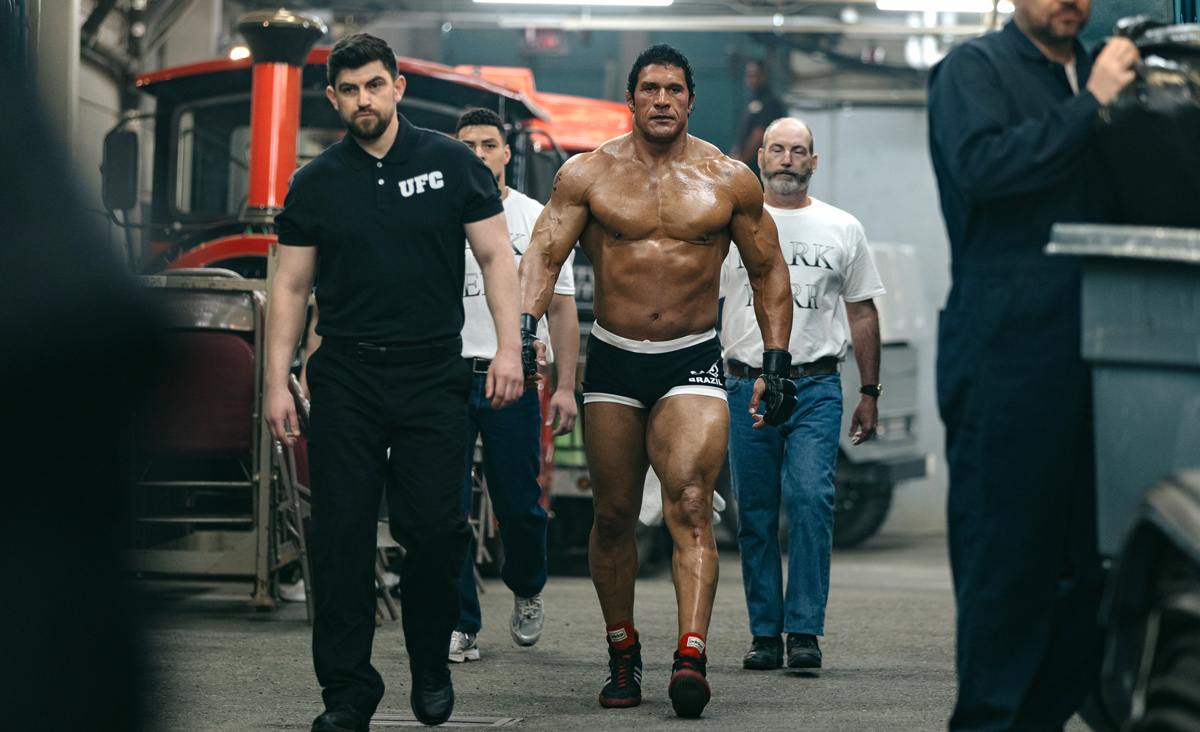
They say to “never let the truth get in the way of a good story,” and it seems like Benny Safdie may have done just that.
For fans of the documentary upon which it’s based (hopefully you’ve read or listened to my retrospectives by now), The Smashing Machine will be familiar, oftentimes charmingly and impressively so. It’s not easy to recreate the feel of impenetrable business meetings with Japanese fight promoters c. 1999, yet Safdie has brought it all back to life in meticulous detail. He’s also teased out far and away the best performance of Dwayne The Rock Johnson’s career, transforming him with wigs and prosthetics and putty ears and forcing him to gain 30 pounds of muscle (which probably took the least amount of convincing)—all to play the affable dad-core Ohio ass kicker, Mark Kerr. Safdie and Johnson’s take on Kerr refuses to reduce him, portraying him as dorky dad (not yet an actual father at this point but spiritually 45 and admiring a suburban neighbor’s lawn), an athlete struggling with the demands of combat sports, a drug abuser, and a star-crossed boyfriend simultaneously. It’s an undeniably compelling performance, and a deservedly reverent one. That Kerr spilled his guts for the world is what made the original The Smashing Machine documentary upon which this was based so great.
Yet at times I wondered if this adaptation was too reverent. One of the aspects of Kerr that makes him so interesting is that he’s so outwardly charming and conventional, this pleasant guy you could easily picture running into at the grocery store or who’d talk your ear off in the hardware aisle, who spends so much of his adult life grinding himself and others into hamburger meat. In The Smashing Machine (2025), Safdie, who wrote and directed, expands on some of the interviews Kerr did in the documentary, explaining why winning a fight in front of 40,000 screaming fans is his ultimate high. In Safdie’s expanded version, Kerr explains why it’s not only a high, but primal, doing things he could’ve never imagined but that feel perfect in the moment, like he’s simply fulfilling an evolutionary design he’d never before recognized. “I want to hurt him and he wants to hurt me,” Johnson’s Kerr says in a voiceover. “When you get hit, there are essentially two reactions: you can either cower in fear or get angry and try to give it back to him. What would you do in that situation? Would you see a cut over his eyes and try to open it with your fingers? …I think you would.”
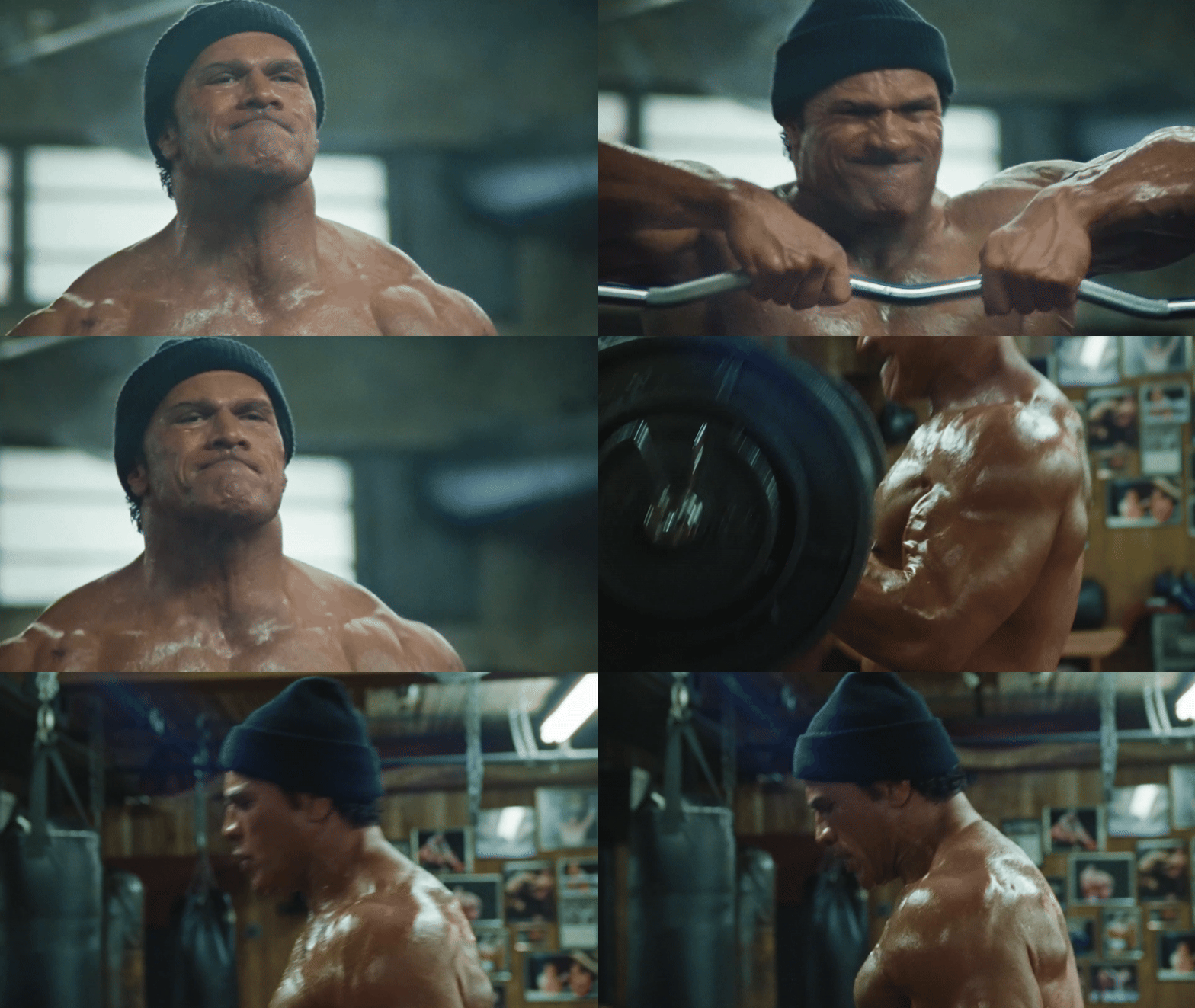
Safdie and Johnson portray Kerr as a guy, not a dumb guy, by any means, who is uncommonly introspective for a professional athlete and wildly articulate—certainly in comparison to his closest contemporary and friend, Mark Coleman, played by actual MMA fighter Ryan Bader—but has in some ways trained away the impulse to imagine potential negative scenarios. It’s a competitive tactic and an act of self-preservation. When a Japanese journalist asks Kerr a seemingly straightforward question, like what would it feel like to lose for the first time, Kerr simply can’t engage the hypothetical. To imagine it in some way would be to make it real. Kerr has spent a lifetime training himself not to do that; it’s part of what allows him to do what he does. That this is both his superpower and his achilles heel, especially in his personal life, is the central theme of the film.
In this and in almost every expanded scene or invented scenario, Safdie proves himself an insightful narrator, successfully blurring the lines between narrative and documentary like few biopics have ever done. Yet Safdie’s invented and expanded scenes are so successful that they tend to raise the question, why didn’t he invent more?
All the aspects of Kerr’s character that Safdie so successfully sharpens in his interview scenes, he notably fails to do in any of the fight scenes that take up so much of the movie. There’s the general problem faced by virtually all combat sports movies, that recreating the look of MMA (or boxing, kickboxing, karate, etc) as it appears in a broadcast is basically impossible. We’re just too used to seeing it. And so even getting 99.9% of the details correct—the takedowns, the slams, the guard recoveries—there’s still that split-second moment where the actor or stunt double is obviously pulling his punches and it shatters the illusion. The question then becomes: why try to shoot it that way? Safdie’s persistent eschewing of Hollywood tricks doesn’t always work for him.
Mark Kerr, this guy who destroys his own body and others’ to achieve that orgasmic high winning brings (a real “smashing machine,” if you will) would seem to offer ample opportunity for some kind of body horror. Why not give us what fight footage can’t? Really drive home that sensation of knuckles smashing flesh and destroying muscle fibers, bones splitting skin, cartilage grinding into mats and bodies until it tears and fills with blood and hardens? We see Johnson wearing gruesome cauliflower ears, why not convey some of what it’s like to get them? We know Mark Kerr got addicted to opiates. Why not show us why he got addicted to them? Safdie’s commitment to the documentary look seems to shut him off from many of The Smashing Machine’s more impressionistic possibilities. And the verité approach turns the supposedly thrilling fight scenes into kind of an anticlimax. Even the punching sound effects are kind of limp.
Safdie does offer some memorable images and canny metaphors. Like when Kerr finds himself in an elevator after losing his first fight. He stands there numb, trying to work out what it means, when the door opens to reveal the Japanese kitchen staff of the venue, pushing a cart full of food. They see this massive sweaty hulk bleeding morosely on the elevator floor and realize they should probably just wait for the next car. Ding! The implication being that Kerr is just more freight, more fresh meat for the hungry fans.
The question of how Kerr grew all that meat is left weirdly unacknowledged. For as many times as the film depicts Kerr shooting opiates, nodding out on opiates, calling his doctor for more opiates, going to the hospital for an opiate overdose, and even adds an invented scene in which Kerr helps mediate an injury flare-up in his then-trainer Bas Rutten (playing himself, natch) by shooting him up with opiates (which I would bet anything was based on a story Rutten told the production team), it never once mentions that other thing Kerr was shooting, steroids. Everyone who followed MMA in the PRIDE days or who has eyes to see knows that most of those guys were juiced to the gills. You had to be. Kerr has admitted it. And isn’t that an important part of the story? That this somewhat reluctant ass kicker, this affable, unassuming guy, had to somewhat reluctantly become part of this sketchy world of illegal and pseudolegal pharmaceuticals, simply because that was what the sport required? And isn’t that a major aspect of the hurt-or-be-hurt ethos? How does a guy who’s so driven to try to do the right thing cope when there is no right thing?
I have to imagine eliding all mention of steroids was part of the cost of getting The Rock to commit to the project, since Johnson has consistently denied ever using steroids after his teens, and still avoids talking about them as much as possible. This meticulous kayfabe has always struck me as weird and a little silly (if Sylvester Stallone can acknowledge HGH use, why can’t obviously enhanced actors and wrestlers?), and more importantly, in a story about a guy whose central qualities were openness and a willingness to be vulnerable, it’s a glaring omission, cavernous and yawning with words things left unsaid. As long as we’re praising Johnson for what is objectively his best and rawest performance, it’s impossible not to note the incongruity of this obvious omission, even in context of fiction. Johnson, the WWE, WME, the UFC (all with overlapping ownership and representation)—there are a lot of powerful parties with interests here, all of them more risk-averse and image-paranoid than Mark Kerr ever was.
