'Him' is All Sizzle, No Steak
This Jordan Peele-produced horror movie(?) is more muddled than elevated.
Welcome to The #Content Report, a newsletter by Vince Mancini. I’ve been writing about movies, culture, and food since the late aughts. Now I’m delivering it straight to you, with none of the autoplay videos, takeover ads, or chumboxes of the ad-ruined internet. Support my work and help me bring back the cool internet by subscribing, sharing, commenting, and keeping it real.
—
Every once in a while, you get a movie whose themes are crystal clear but whose story is a hopeless muddle. That, in a nutshell, is Him, which is sort of like reading a cookbook for a good movie—ingredients seem logical enough, but no one finished figuring out how they’d go together. It lurches from intriguing idea to intriguing idea, without much in the way of connective tissue or follow through. Football: it’s a brutal, merciless, pseudo-religious, and kinda racist business. But that much we know from posters and trailers. As for the smaller matters, like who these characters are and why they do what they do, it’s all up in the air.
Him is famously produced by Jordan Peele—as touted above the title in most of Him’s marketing—making it easy to forget that he didn’t actually write or direct, as in Get Out, Us, and Nope. Justin Tipping is in the director’s chair this time around, working from a script by himself, Zack Akers, and Skip Bronkie (not enough guys named “Skip Bronkie” these days, I’m always saying). Him’s story concerns Cameron Cade, a young baller who’s been trained by his father, basically since birth, to be “the next GOAT.”
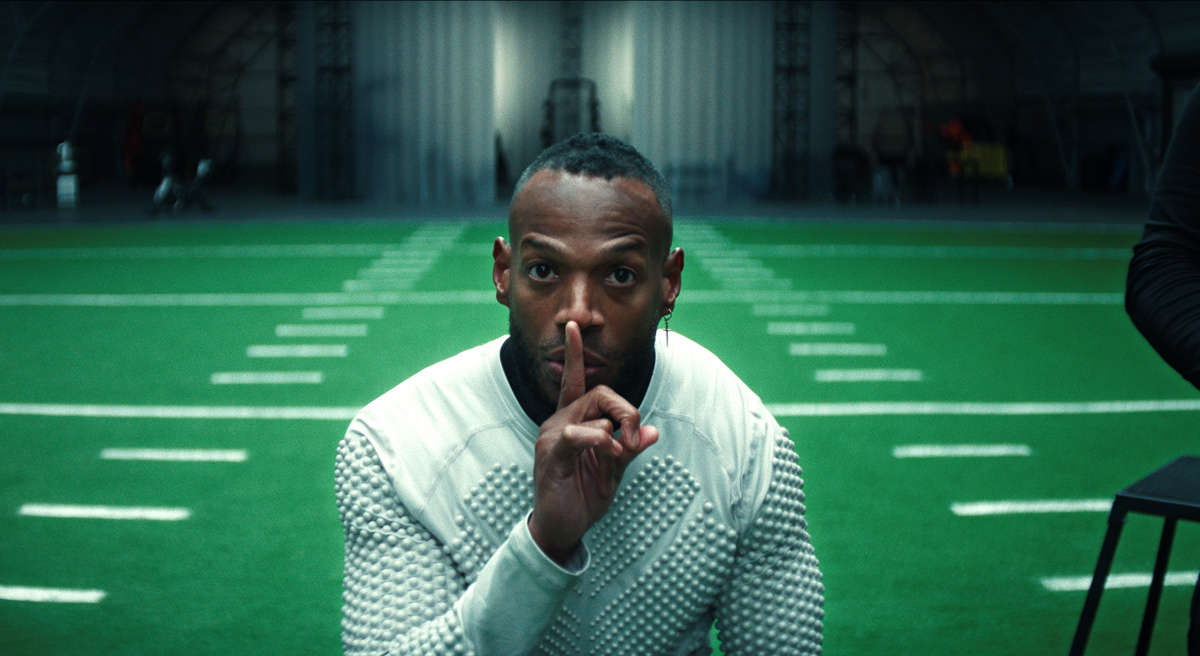
Of course, there can be only one GOAT—the last three letters stipulating “…of all time”—meaning Cam has to be not just good, but better than the present GOAT, Isaiah White (Marlon Wayans). Cam’s military dad makes him obsessively study Isaiah game tape like Isaiah is the human Rosetta Stone of GOATitude, starting when Cam is barely out of pull-ups. “You see that, son? That’s what a MAN looks like!” the drill sergeant drills into his son as they watch Isaiah play through injury on the way to one of his eight Super Bowl rings.
“You gonna the be the next Isaiah?”
“YEAH!”
“You gonna be the next GOAT?”
“YEAH!”
“Whose time is it?”
“MY TIME!”
Gen Z’s seemingly boundless love of sports clichés (“let’s go!!!”) is one of the hardest things for me to accept about them, but I digress. We learn about Isaiah’s eight rings, by the way, in the form of a news montage, the existence of which is fast becoming a sure sign that you’re watching a mediocre movie. Why bother using the cinematic language to deliver exposition (the opening shot of Rear Window being the classic film school example) when you can just have a newsperson tell the audience everything we need to know? Who wouldn’t want more cable news in our movies? Plus it establishes that we’re living in an attention economy or whatever.
Him, oddly, feels like it never entirely drops the news-montage-as-exposition conceit. Aside from the opening news montage not being its last, there are times when things happen to Cam and someone offscreen explains it without ever being shown, leaving us to wonder whether the voice was another character in Cam’s world, or some voice-of-god narrator meant to guide us through the action. It all adds to the sense of Him feeling more like a movie being pitched to us rather than a movie in its own right.
From Cam’s childhood, the film jumps forward in time, to Cam, his father now present only as a framed memorial on the wall (I guess they did remember the Rear Window opening shot after all), as he’s now the consensus number one QB in college football (cue another news montage). Adult Cam is played by Tyriq Withers, who is both easy on the eyes and passes the basic smell test for “stud athlete”—no easy lift in today’s British/Australian infiltrated, post-Disney Channel Hollywood. Often, you’d imagine casting directors having to choose between an actor who looks too British to play football and one who looks too much like an ex-child actor. Casting, however, is one of Him’s strong suits, along with Kira Kelly’s cinematography, which renders Withers luminescent and iconic. That he does look like an ESPN Magazine cover boy carries the film along for a while.
Where did Cam go to college? Doesn’t matter. He’s about to be drafted first by Isaiah White’s team, the San Antonio Saviors, the only team in the film’s fictionalized NFL that ever gets mentioned (San Antonio, lol. It seems like a fluke that they even have an NBA franchise!). All Cam has to do is ace the combine.
So he’s training late one night at some expensive facility (the last one there, natch, you have to train pretty hard to be the GOAT) when the facilities manager heads home, telling Cam to shut off the lights when he leaves. Cam zips a couple passes off the uprights, presumably as his little ritual (sports are sort of like religion in that way, have you noticed?). DOING! DOING! After the last ball ricochets off the side bar, it spins uncannily on the turf, like a pigskin dreidel after a good twist. Cam walks over to take a closer look, and just then, a large figure in a goat’s head mask and cloak (think Tarot Card imagery) appears behind him, whacking Cam in the head with a metal-tipped staff before the screen goes dark.
In the moment, it feels like a bold dramatic choice. In retrospect, the scene is noteworthy for how little narrative lifting it does at all. You could cut this scene and Him would be the exact same movie. That the writing can’t seem to yes-and itself in this way is probably why Him feels so much like a collection of unintegrated elements. It’s missing a coherent internal logic, and the connections between events are all gooey.
Post Tarot Man-bashing, Cam wakes up to a doctor examining his CT scan. She tells Cam that the risk of another Traumatic Brain Injury is too high, and that her professional recommendation is for him to quit playing football forever. Cam’s mom tells him not to worry about it, to just pray and keep playing and take one day at a time and everything will work out fine. Weighing the risk of a dementia-inducing concussion against potential fame and fortune would seem to be a theme worth exploring in a football movie (just ask Tua Tagovailoa). Yet here again the movie just sort of moves onto something else. Cam tells the press (the ever-present press) that “I’ve taken harder hits on the field” and goes on with preparing for the combine. Or so it seems, until he cracks under the pressure.
Or…. something. Actually, we cut straight from Cam snapping at his brother while preparing for the combine, to his agent (an enjoyable Tim Heidecker) explaining to reporters why Cam won’t be participating in the combine. It’s unclear what the deciding factor was, or, for that matter, what the general public actually thinks happened the night we saw Cam get domed by an understudy for Gwar. Cam’s career is in limbo, at least for about 90 seconds of screen time, until, while attending some draft week chains-and-blunts party, Cam gets a phone call from Heidecker. The Saviors still want him, Heidecker explains. They’re now the only team that wants him (and still the only team that seems to exist in the reality of this movie). Their offer is contingent upon one thing: Cam spending a week with Isaiah White at White’s high desert compound as a professional audition.
Naturally Cam accepts, and it’s out in the desert where things get weird. Only… not that weird. The toughest task for any horror filmmaker is that a good horror script has to exist in the natural world and in the fantastic simultaneously. There usually has to be some kind of supernatural evil afoot for it to be a horror movie, but that evil still has to operate with enough internal logic for the heroes to plausibly overcome it. Him is characterized by a lot of scenes that aren’t quite spooky enough to be satisfyingly supernatural, but that don’t quite square with a grounded reality either. It has a lot of ideas, but it often doesn’t pass the what-is-actually-happening test.
Marlon Wayans, at least, who I’ve always thought was better at drama than comedy despite his last name, is a compelling (and, like, Withers, gorgeously shot) presence, adept at a mix of congeniality and menace. Cam can never quite tell if Isaiah sees himself as Cam’s mentor or his rival. Does Isaiah want to train the next GOAT or stay the GOAT himself? Like highlanders, there can be only one. There’s something there, the film just can’t quite capitalize on it, because it never really elaborates on its obvious hooks. There are a lot of exchanges between the two of them in which you kinda sorta get the gist of where the film might be going, but that feel like they maybe needed a few more writing passes. Isaiah is doing some taxidermy when Cam walks in the door (another subplot broached and then ignored) and then asks Cam if Cam knows how his position of quarterback even came to be.
According to Isaiah, it all goes back to the Carlisle Indians (which, at the very least, was a real team). In an effort to compete with the big white boys from the preppy universities they played, Isaiah explains, the Carlisle Indians had to employ superior organization and cunning, which eventually led to the forward pass—which the white boys, who favored smashmouth slobberknockers to thinking, hated. But so many young white boys were dying playing their brutal sport that none other than the President of the United States at the time eventually had to step in and advocate for the forward pass (again, sort of based on reality). The Indians, according to Isaiah, even invented the spiral. And then they became a mascot. You don’t want to become a mascot, do you?
There are a couple callbacks to this concept, of “not becoming a mascot,” and the logic of it never quite follows. I mean, I get it in the sense that “The Redskins” became a mascot, as did a bunch of other Native American inspired team names, but what they did or couldn’t do in order to “become a mascot” never quite makes sense in the context of football. Him is clearly attempting some sort of comment on race and colonialism. Isaiah and Cam’s mascot now is “The Saviors”. As in, the WHITE Saviors? And their mascot (the visual representation in this case, not the name) looks like a Spanish conquistador. You know, the guys who conquered/“saved” the Native Americans! Raising the question of who actually “became the mascot” in this case. I guess they both did? I dunno, man. A lot of Him just feel like unincorporated research.
Cam’s week of hazing/training goes on from there, with some free agents used as cannon fodder, a maybe evil personal physician played by Jim Jeffries, Isaiah’s definitely-I’m-pretty-sure evil temptress of a wife (played by former Kanye and Safdie Brothers muse Julia Fox, in classic Julia Fox presentation with black eyeshadow and white eyebrows) and all kinds of athletic dark arts, like steroids, hyperbaric chambers, and blood doping. Would you believe NFL stardom has a dark side?? Cam’s character will occasionally acknowledge these things with flippant dialogue, but more in a way like he’s just noticing the script of the movie he’s in rather than contributing anything to it. “You were trying to inject me with your blood on some white people shit,” Cam says to Isaiah at one point.
“On some white people shit,” as in Peter Thiel/Bryan Johnson and their infamous blood boys? I guess so. If I squint really hard I can kinda see what they were maybe going for. “Fuck you and fuck your eyebrows,” Cam says to Julia Fox in another scene, which… sure. She definitely does have weird eyebrows! Nice of you to acknowledge this in the third act.
Most of Him again falls into this same weird middle ground between the supernatural and the literal that ends up working as neither. There’s a big bloody finale and I’m not sure whether the implication was supposed to be that Cam succeeded by usurping Isaiah’s status as the GOAT on his own terms, or if he succeeded by realizing that it was all a trap and is thus quitting football. Those are the two main possibilities for this character who was trained to want to become the GOAT, and I feel like I should leave the movie understanding which one he chose.
Him is ultimately a movie with many themes and allusions and leitmotifs, at which Justin Tipping throws all of his considerable arsenal of technical and stylizational tricks (many of which at least look slick, in a vacuum). But at the end of the day, it feels like they had every ingredient for creating an elevated horror movie except the one that counts: having a coherent horror movie in the first place. It seems to prove that you can’t elevate what isn’t there.
Thanks for reading The #Content Report, By Vince Mancini! This post is public so feel free to share it.
