It's a Gothic Romance! 'Frankenstein' is Another Beautiful Head Scratcher from Guillermo Del Toro
Another Guillermo Del Toro movie I desperately wanted to love but came away from wishing he would get an editor.
Welcome to The #Content Report, a newsletter by Vince Mancini. I’ve been writing about movies, culture, and food since the late aughts. Now I’m delivering it straight to you, with none of the autoplay videos, takeover ads, or chumboxes of the ad-ruined internet. Support my work and help me bring back the cool internet by subscribing, sharing, commenting, and keeping it real.
—
I used to think of Guillermo Del Toro as the Mexican Peter Jackson: a lovable character with an obvious passion for movies and a knack for world-building, but whose seeming inability to self-edit tends to make his movies a little… tedious. Coming away from Del Toro’s latest, Frankenstein, the comparison seems unfair. Del Toro isn’t nearly as tedious as Peter Jackson, his compositions are better, and he seems far less obsessed with the technical aspects of filmmaking at the expense of everything else.
I’m starting to think of Del Toro as more of a reverse Robert Eggers. Where Eggers can take an old story that I assumed I’d understood or never much bothered to think about before, like Dracula in Nosferatu or Hamlet in The Northman, and bring me to some new understanding, Del Toro can take an old story I thought I understood and turn it into a baffling muddle. Was Mary Shelley’s book like this? Is this just what novels were like before typewriters and word processors, rambling and discursive and contradictory, full of sound and fury, signifying nothing?
Admittedly I’m no Mary Shelley scholar, but I’d always imagined Frankenstein was a story about scientific hubris and man’s solipsistic conception of the soul—admittedly a read based more on the parts of the story that had filtered down through the last 200 years of pop culture than on the original work. Del Toro’s Frankenstein adaptation starts off seeming like that’s what it’s about, and then it zigs and zags and turns back on itself, characters appear and disappear without especially good reasons, until I ultimately can’t tell what it’s about at all. I was drawn in by Del Toro’s compelling compositions and meticulous production design (that, and genuine affection for Pan’s Labyrinth is why I’ve never been able to write him off entirely), but ultimately left me wondering why he wanted to tell this story in the first place. A sexy Frankenstein, huh? Well golly.
During the press tour for Crimson Peak, Del Toro’s dogged insistence that “It’s a gothic romance!” became something of a meme. In retrospect, maybe it says something that he was so tenacious about asserting a vibe and a set of influences and not a theme or a topic. I can tell Frankenstein is a gothic romance. I’m just not sure what it’s about.
There seems to come a time in all Guillermo Del Toro films where the action starts to feel like a kid playing with his dolls. I don’t mean to say that glibly; I just don’t think there’s a better way to describe it. The character motivations seem to break down and the internal story logic becomes so incoherent that it all feels like “and the GI Joe flies over here now!” You lose a sense of the characters’ agency, and suddenly all you see is the sandbox.
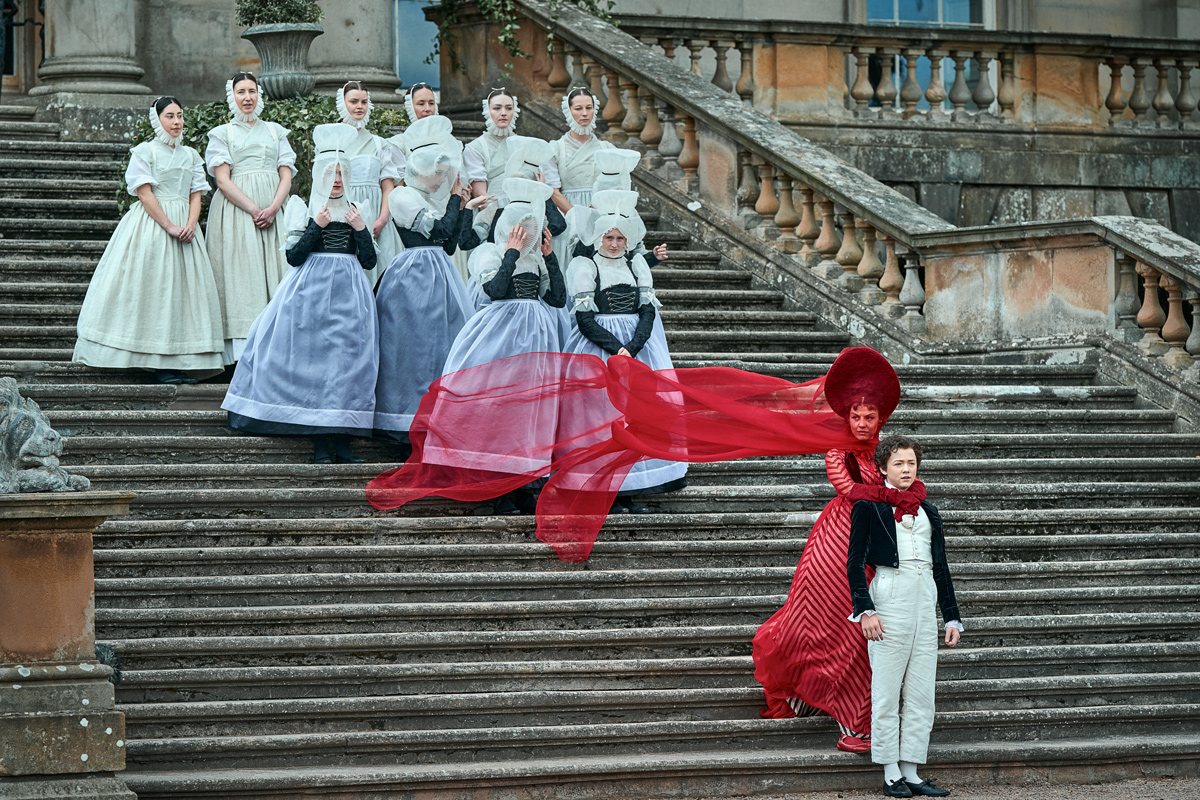
Frankenstein opens on a Norwegian research vessel, trapped in Arctic Ice on one of those classically quixotic Victorian expeditions to the North Pole (a bit of red meat for the Stan Rogers hive). Del Toro’s compositions; his character, costume, and production designs, are all almost endlessly compelling, at least whenever he’s not gumming them up with bad CGI (the sailors’ coats and frosty beards, so lustrous and tactile, look excellent; the digital ice boulders less so). The sailors soon discover that they aren’t alone in the North Sea ice. They come upon a badly injured man wheezing amongst the flaming wreckage of what used to be his dog sled. He’s Victor (Oscar Isaac), name confirmed by the giant, fur-clad yeti creature screaming his name. Seemingly immune to musket fire, the super strength yeti man tosses Norwegians around like twigs before eventually falling through the ice. The captain has Victor brought back to his quarters where, lying on a couch, Victor begins to unfold his tale.
He starts all the way back at the beginning too, during his childhood. You’d think the captain would be like, “Hey, man, think you could fast forward to the super-strength-monster-trying-to-kill-us part?” But this is olden times, people were more patient then.
We learn that Victor was the son of a minor aristocrat (Charles Dance, aka Tywin Lannister), who treats his wife (Mia Goth) like a baby making machine and his son like an extension of his brand. The gorgeous alpine setting and exuberant costuming do most of the heavy lifting, but suffice it to say, part of the Frankenstein brand is being a surgeon. Victor’s father trains him in the medical arts (think: anatomy lessons and corporal punishment), about which Victor is mostly indifferent at first. Then his beloved mother dies while giving birth to his younger brother, at which point Victor vows to conquer death to avenge his mother, and to conquer medicine and surpass his father, whom he suspects didn’t try hard enough to save her. It’s also the beginning of Victor’s lifelong passive-aggressive rivalry with his younger brother (the grown up version played by Felix Kammerer from All Quiet on the Western Front), whom Victor resents for killing their mother, for being their father’s favorite, and for his sunny disposition that most prefer to Victor’s moodiness. “He was the sunshine and I the storm cloud,” Victor says in his on-the-nose voiceover.
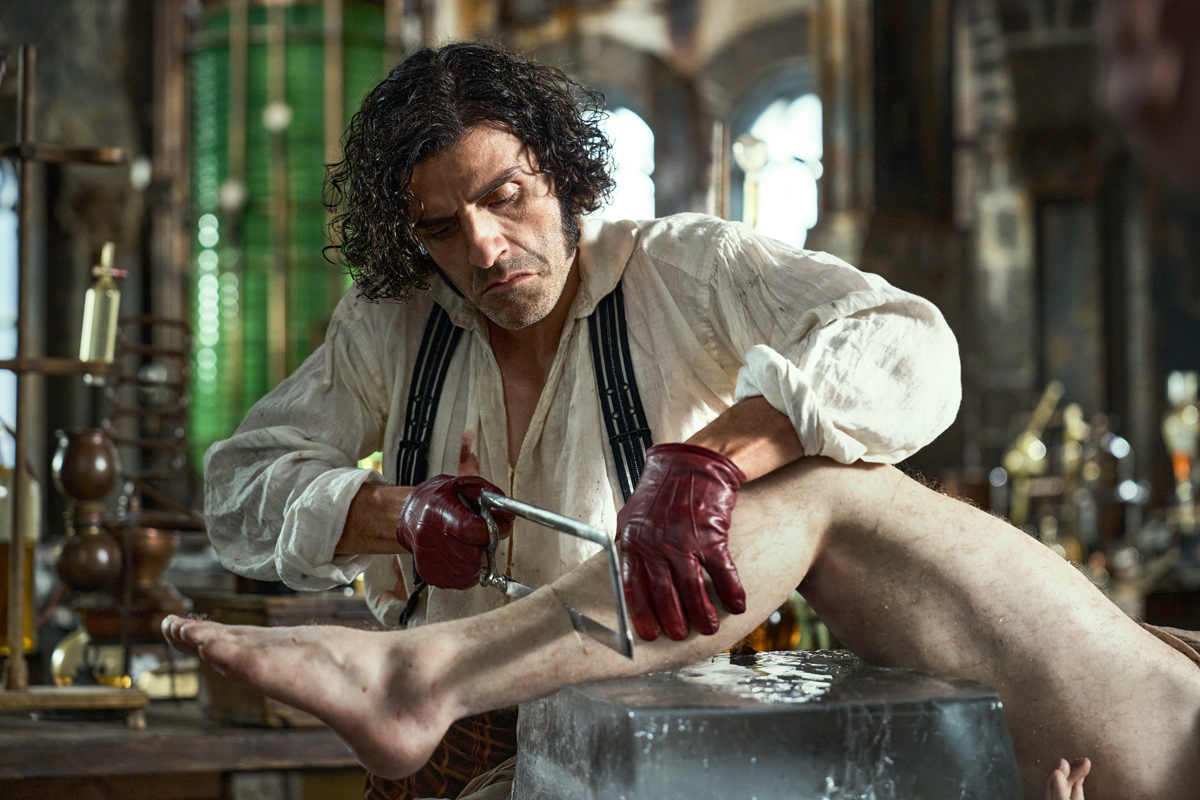
Fast-forward to adulthood, and Victor is a surgeon at the medical college, freaking out his colleagues during a disciplinary hearing by bringing a skinless arm and head with exposed brain back to life, if only briefly. Del Toro tends to shine during these grounded moments of the macabre, the ones the require great lighting and a flair for splatter but no CGI. After Victor gets expelled for hanging brain and general freaky deakiness, he’s visited by an associate of his brother, Harlander, played by Christoph Waltz. A wealthy arms manufacturer, Harlander soon becomes Victor’s unlikely benefactor, agreeing to bankroll anything Victor needs for his quest to conquer death—under the stipulation that Victor will one day do Harlander a solid, should he need it. (Gee, I wonder what it is).
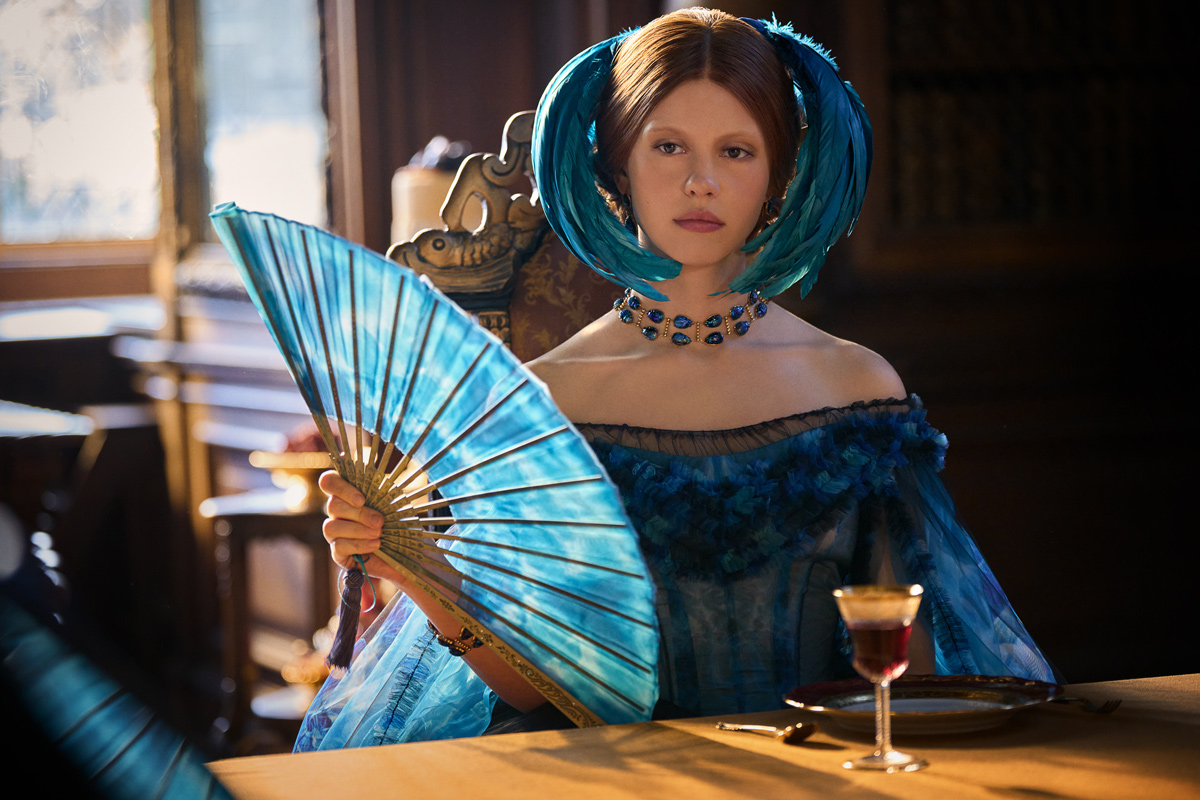
It’s at this point that the film basically devolves into a tangle of competing themes and storylines. William arrives from Vienna with his fiancee, Elizabeth, whom Victor instantly begins to covet, perhaps on account of she’s played by Mia Goth, the same actress as his mother (paging Dr. Freud!). Harlander buys Victor a big creepy tower, whatever the Victorian equivalent is of an abandoned power plant, and William sets to work trying to put Victor’s elaborate demands and exacting standards into practice as they build it into a corpse-reviving facility. Elizabeth, meanwhile, clowns Victor for his megalomaniacal tendencies and chides him for his inability to see the humanity in others. You keep banging on about your experiments, won’t you think of the poor soldier boys, who died fighting over rich men’s whims?
Of course he doesn’t! Victor thinks only of his boner, which is now but more tumescent, thanks to Elizabeth’s supple-lipped negging. (Mia Goth is a hell of an actress, as she proved in Ti West’s X trilogy, though here she has an odd habit of delivering most of her lines through mostly closed teeth).
Ah, but wait, did you say “soldiers?” Yes, there’s a war on (the Siege of Sevastapol, maybe? a title card did tell us that it’s 1855), which is both the reason Harlander the arms merchant can afford Victor’s demands, and the reason Victor has an ample supply of corpses. The way Victor and Harlander treat the dead as mere pawns in their game seems like it’s suggesting some kind of a Big Theme. Don’t the soldiers too have loves and dreams and souls of their own? Perhaps, but Del Toro seems to care less about the dead boys and their baggage than even Victor or Harlander. He has so much more to get to! I promise you’ll be exhausted by the end of it!
First, Victor has a corpse to raise and a fiancée to steal. He’s only successful in the former, creating a giant, oddly sexy marble statue of a Frankenstein’s monster, played by Jacob Elordi, looking like Phantom of the Opera meets one of the engineers from Prometheus. Is that an in-joke, since the full title of the original novel was “Frankenstein; or, The Modern Prometheus?” Either way, Del Toro comes tantalizingly close to creating the proverbial Hot Frankenstein Who Fucks. (If only he had actually fucked, automatically a much better movie).
Victor succeeds in raising him from dead parts, but is soon disappointed in his creation—who, despite being hot and presumably having a huge cock (sadly covered by a bandage for the whole film; hang some dong you cowards!), can, Groot-like, only say one word: “Victor.” Victor keeps his creature chained in the tower basement (it’s never entirely clear why Victor needed this tower in the first place), and occasionally lovingly shaves his head to keep him cueball smooth. I wasn’t sure what to make of this, other than that between the monster’s head, Oscar Isaac’s baby smooth chest, and Mia Goth’s famously ghostly eyebrows, Del Toro seems to favor a hairless aesthetic (as well as Tim Burtony scores, courtesy of Alexandre Desplat, aping Edward Scissorhands). I’m not even going to explain what happens to Harlander and William, who quickly become entirely superfluous to the narrative.
Elizabeth, at least, seems capable of seeing “the monster” as a sentient being, in contrast to Victor. A bunch of other stuff happens. The film switches title cards about 90 minutes in and the story starts being narrated from the monster’s perspective. He escapes Victor and goes to live in the engine room of an old mill, where he learns familial love from spying on the mill family, and eventually the old blind patriarch teaches him to read famous books like Yeats and Paradise Lost. He learns the cruelty of existence from a pack of wolves (badly CGI’d), who just show up and slaughter entire families from time to time like a Biblical plague. It all feels very rushed and scattered, but probably Del Toro is doing an art of some kind and I just haven’t read enough Yeats to get it. It’s a gothic romance!
The trouble isn’t so much that so much stuff keeps happening, it’s that I couldn’t figure why it was happening. It doesn’t track. Character motivations continually shift. The monster wants to die, to punish Victor, to win Victor’s love, and to have a companion, at various points. Victor yearns for notoriety, is undone by hubris, seeks redemption and atonement. Elizabeth wants to scold, to mother the monster or maybe just fuck the monster, and to die theatrically. At one point the characters literally just walk to the North Pole. GI Joe goes over here now!
