'Eden' is a Mid Telling of an Amazing True Story
Ron Howard's latest doesn't quite stick the landing, but it's an entertaining ride in which Jude Law hangs dong.
Welcome to The #Content Report, a newsletter by Vince Mancini. I’ve been writing about movies, culture, and food since the late aughts. Now I’m delivering it straight to you, with none of the autoplay videos, takeover ads, or chumboxes of the ad-ruined internet. Support my work and help me bring back the cool internet by subscribing, sharing, commenting, and keeping it real.
—
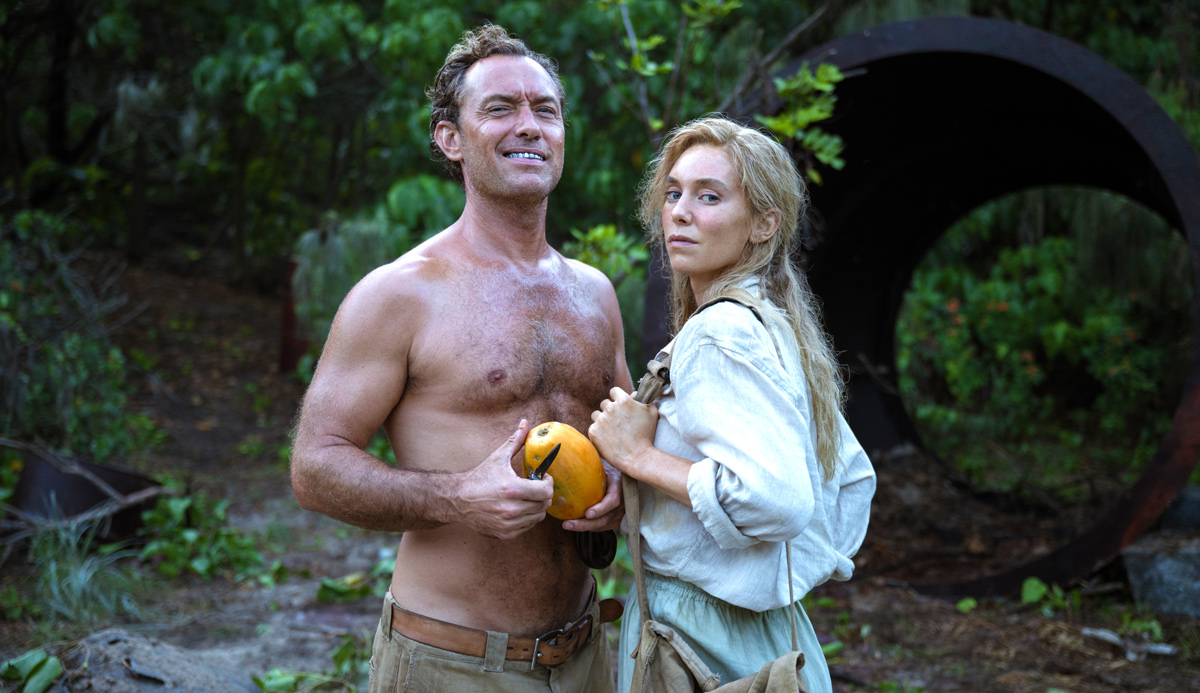
Island settings are endlessly attractive to storytellers, probably for the same reasons they draw biologists. It’s easy to see, in isolated islands, the potential for societal do-overs. The isolation allows for endless theories to be put to the test. Does the socialist share resources? The vegetarian kill animals? The economist rely on the invisible hand of the market? In Ron Howard’s filmmaking hands, only one thing is for certain: Jude Law hangs dong.
The themes of Howard’s latest, curiously under-the-radar release, Eden, are well-enough represented in the title. My own bookshelf includes probably ten different books about remote islands, including two or three about Pitcairn alone, not including Mutiny on the Bounty, the story that made it famous, spawning movie versions starring Clark Gable and Mel Gibson, respectively. Which is to say: I too heed the siren call of the archipelago (I recommend J. Maarten' Troost’s South Pacific trilogy).
The source material for Eden (with screenplay by Noah Pink) is self-evidently fascinating, a tragomantic Weimar-era murder mystery about a colony of eccentric Germans who attempted to start a new civilization on a formerly uninhabited island in the Galapagos called Floreana. As Eden’s opening crawl tells us, it’s 1929. Society is full of disillusioned WWI veterans, fascism is on the rise worldwide, and the stock market has just crashed “in the wake of the war.”
“…in the wake of the war” is a bit of a headscratcher, a strange way to describe a stock market crash 11 years earlier. An odd bit of wording easily overlooked? Perhaps, though there’s also a read on Eden as characterized by a rush to gloss over history and move straight into those supposedly timeless, edennic themes. Such that when it fails to entirely come together at the end, you end up wondering whether the whole thing was built on a shaky foundation of slapdash historiography. Noah Pink and Ron Howard tend to yadda-yadda some of Floreana’s peculiar specifics that may, in retrospect, contain within them more emotional truths than what it seems they’re attempting to sell. The result is a solidly entertaining yarn that nonetheless can’t help but draw attention to all the ways in which it falls short.
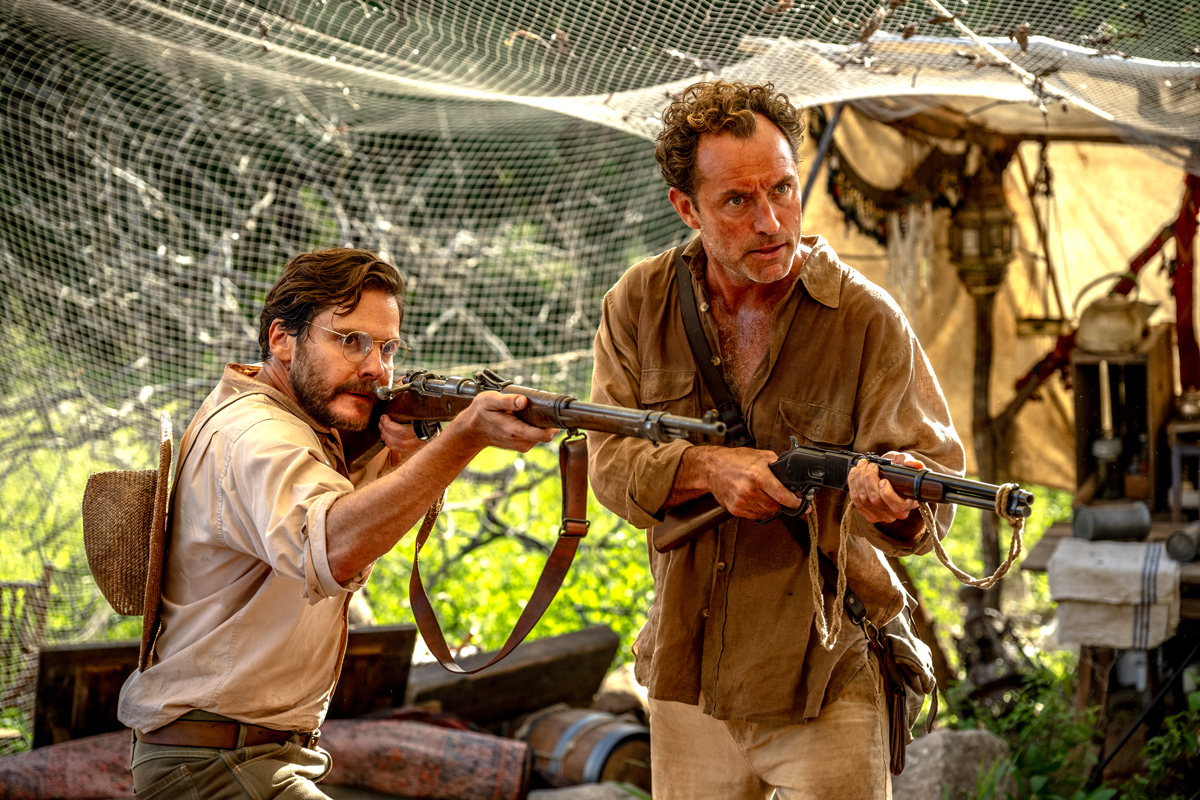
Jude Law and Vanessa Kirby play Floreana’s “original” inhabitants, the so-called “Adam and Eve of the Pacific,” Frederick Ritter and Dore Strauch—he a former dentist who plans to write a blueprint for an entirely new kind of society, free of old hangups like war, religion, and meat-eating, she his MS-afflicted lover and occasionally fractious partner. The two are given to quoting Nietszche like scripture.
Heinz Wittmer (Daniel Brühl), meanwhile, a haunted war veteran, has read about Ritter in the papers (Ritter sends dispatches to society on passing ships) and been inspired by Ritter’s vision, bringing along his wife, Margret (Sydney Sweeney) and early teens son, Harry (Jonathan Tittel) as both Ritter’s disciples and refugees from what he sees as a crumbling society.
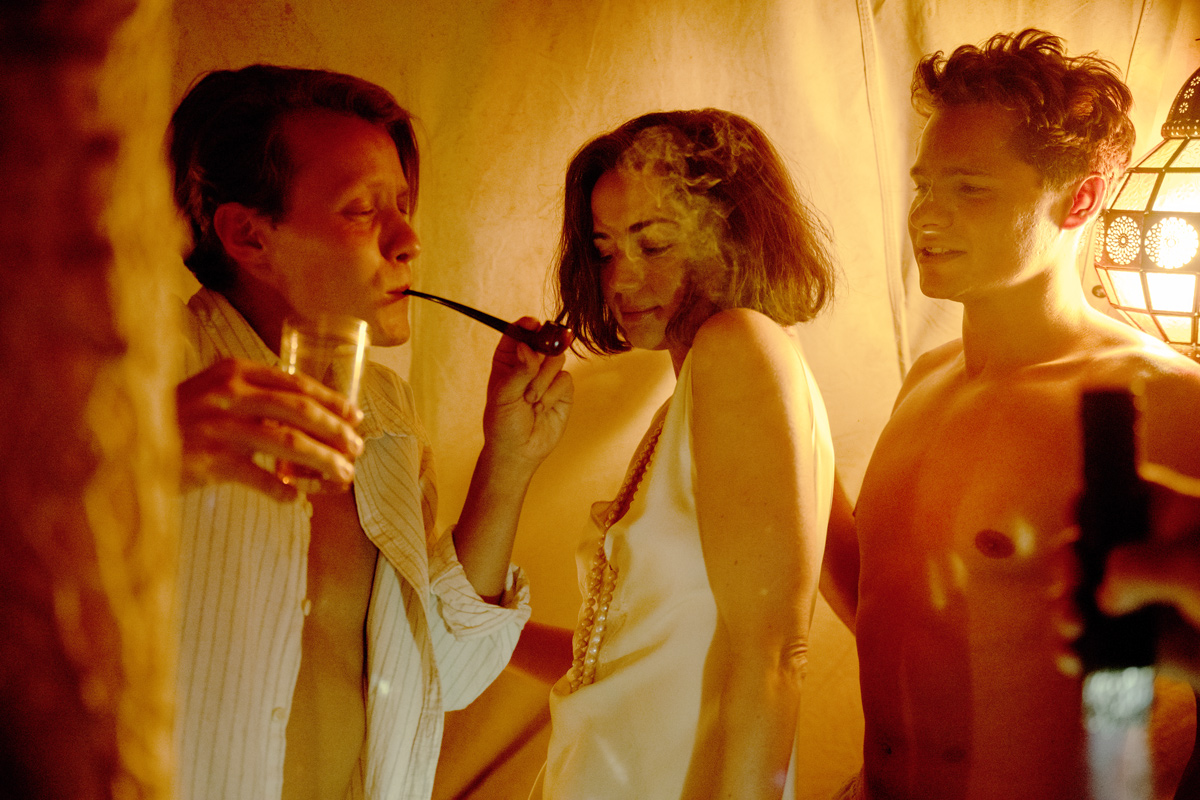
Of course, nothing fucks up a hermetic misanthrope’s vision of Eden worse than additional humans, and so the Wittmers’ arrival puts Ritter’s avowed humanism to the test, which it mostly fails. Ritter (and Strauch) greet their would-be disciples somewhat coldly. But even the Wittmers seem like a dream compared to the island’s next arrival, the self-styled “Baroness Antonia Wagner von Wehrborn Bosquet,” a fake aristocrat played by Ana De Armas, and her two besotted young lovers Rudolph and Robert (Felix Kammerer from All Quiet on the Western Front and Toby Wallace from Babyteeth). The Baroness has grand plans to turn Floreana into an exclusive resort for millionaires, while the lithe twinks mostly compete for her affections.
The three groups constantly scheme and plot against one another, not to mention developing internal divisions, jealousies, and love triangles. Ritter’s initial plan, to sabotage the Wittmers by sending them to live in some caves where he thinks they’ll fail, ultimately backfires when the Wittmers quickly display grit and ingenuity, building a working well and a thriving garden that Ritter soon has to borrow from, with an assist from a feral pig (played with aplomb by your mom). The Wittmers, in turn, first come upon the Baroness’s throuple skinny dipping in their water supply. How far does the Wittmer’s own spirit of community extend? That everyone on this deserted island is notably hot—from Ana De Armas to Sydney Sweeney to Jude Law on down—is the kind of movie magic we know and appreciate.
The Wittmers, according to some of the original accounts, were described as “practicing nudists.” Everyone on this island, it seems, were dreamy Bohemians, in one way or another, of that particular ilk that seemed to thrive in the libertine inter-war years, particularly in Germany (see: the writings of Stefan Zweig or Christopher Isherwood). It was a time when the idea that humanity could forever outgrow or outlaw war itself was taken up in earnest—albeit coexisting uneasily with widespread poverty. And if we could outgrow war, what else could we do away with?
It’s not as if Eden glosses over its characters’ idealism and willing embrace of new philosophies. Jude Law hanging dong for a scene seems an allusion to the nudism, the Baroness’s dual lovers represent free love, and a scene in which Ritter/Strauch attempt some kind of transcendental meditation mid-coitus speak to their attempts to reinvent spirituality and religion. Yet the film seems to work overtime to present the Wittmers as morally upright and industrious, Ritter/Strauch as embittered lapsed romantics, and the Baroness as a fantasy-obsessed creature of pure transactionality and unrestrained id.
There’s certainly some historical justification for that based on how things eventually worked out, but I’m not sure the groups’ differences weren’t less important than their similarities. Eden’s opening crawl also tells us that the story is based on “the survivors’ accounts.” And yet the film seems entirely blind to the old adage that history is written by the winners, to the point that the winners in this story, wouldn’t you know, end up seeming the most moral. (I’m being vague as to avoid spoiling the 90-year-old source material here, since I only learned of it myself thanks to the movie).
Even stranger is the way the movie treats G. Allan Hancock (Richard Roxburgh), the millionaire playboy oil-tycoon (and descendant of actual royalty) who famously visited Floreana multiple times, including once in order to shoot a pirate film starring the Baroness. Eden presents Hancock not only as an unbiased observer, but essentially as the voice of reason and the film’s moral center, easily able to see through the Baroness’ act and uniquely capable of resisting her charms.
It’s unfortunate to have the rich guy also be the good guy, and also to depict the lone American as unmoved by Old Europe’s silly affectations and immune to their petty squabbles. True in this case or not, it’s so perfectly in lockstep with the last 150 years of American self-mythologizing (complete with having him played by an Australian) that it feels propagandistic. Also, you’re telling me that the millionaire playboy so fascinated by German naturists as to make a pirate movie about them is going to turn down a one-night-stand with a fake Baroness? Puh-lease. At least make him gay or something.
