'The Bone Temple' Trades Brexit for Religion, Gore, and Dongs
I can't believe this franchise is still pretty good.
Welcome to The #Content Report, a newsletter by Vince Mancini. I’ve been writing about movies, culture, and food since the late aughts. Now I’m delivering it straight to you, with none of the autoplay videos, takeover ads, or chumboxes of the ad-ruined internet. Support my work and help me bring back the cool internet by subscribing, sharing, commenting, and keeping it real.
—
28 Years Later, Alex Garland and Danny Boyle’s 19-years-later sequel to the previous 28 [Time Period] zombie movie, was heavy on the Brexit and English exceptionalism metaphors. It took place on an isolated English isle in a post-apocalyptic setting after the British isles as a whole had already been walled off and quarantined by the larger European continent as a sort of rage-virus-infected, no-rules zoo enclosure for Bread Pie Eaters.
Boyle wasn’t subtle with his allusions, folding in everything from the Battle of Agincourt to Kipling poems to The Blitz (via interstitial found footage montage), to create a sort of zombified, funhouse mirror depiction of a society trying to construct a unifying cultural mythos out of pop culture detritus and half-remembered propaganda (but hey, enough about pop country music!). It was compelling in that, and funny too; especially during a scene in which a “cosmopolitan” Swedish soldier, stranded in England, shows a young feral Briton a picture of his fiancee, and the British boy, seeing her lip filler and hair extensions, assumes she’s had an allergic reaction to shellfish.
28 Years Later was pretty great until it got downright bizarre at the end, with the weinerish protagonist, Spike (Alfie Williams) surviving his own coming-of-age rites, a full zombie holocaust, and meeting his own Zombie Colonel Kurtz just in time to be captured by a gang of roving ninjas dressed like Jimmy Savile. The ending (which did tie into the otherwise disconnected opening scene, in which we saw a young boy named Jimmy take refuge under a church while his vicar father was murdered by zombies) was such a left turn that it almost felt like a prank. Not enough to ruin the mostly-good movie that had come before, but certainly not something that enhanced it either.
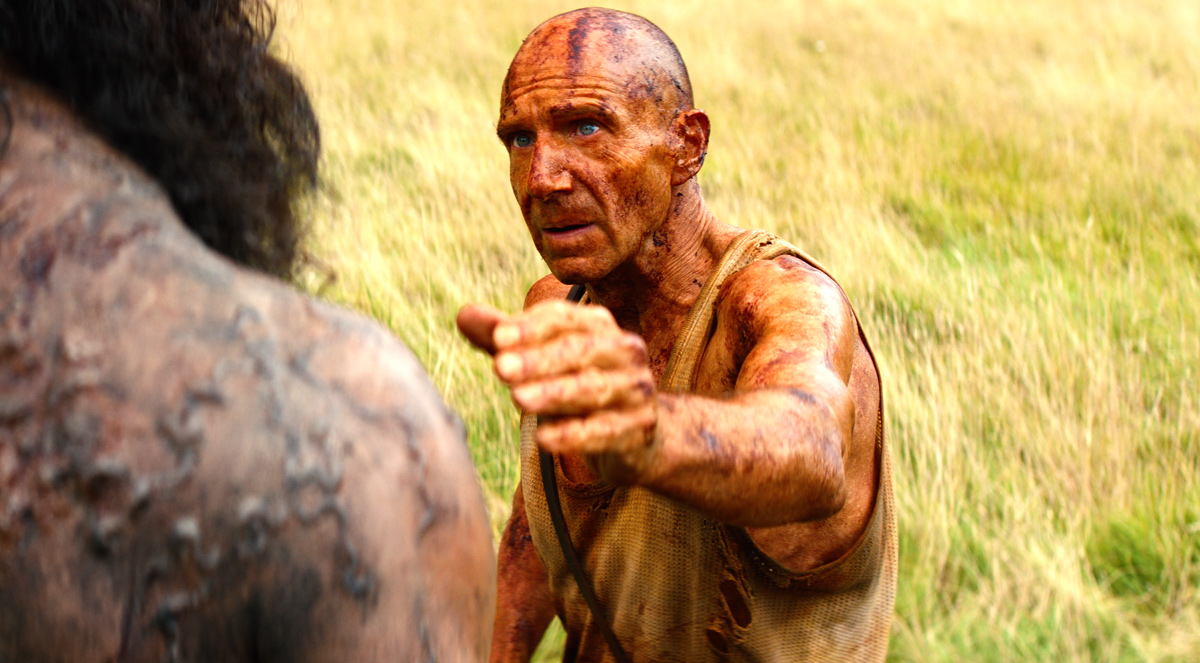
And that’s where the new 28 Years Later: The Bone Temple, written by Alex Garland and directed by Nia DaCosta, begins: with young Spike being inducted into this pseudo-religious cult of parasitic Jimmies. While this installment (shot back to back with the first, and rumored to be the second of three) lacks some of the peculiarly British pathos that made the last so great, trading English isolationism for Judeo-Christian mumbo jumbo (DaCosta is American), it coheres better as a straightforward thriller, and at the very least includes a truly sublime musical interlude set to Iron Maiden that will inevitably be one of the finest scenes I saw this year. If not, it will have been an incredible year. Above all, The Bone Temple is a film that poses the question: Orange you glad they brought back a jacked Ralph Fiennes slathered in iodine? Readers, I am.
While I don’t believe I’m sufficiently British to properly explain who Jimmy Savile is, from what I’ve gleaned from various readings over the years, the cliff’s notes is that, to the British, he’s sort of like if Bob Hope or Dick Clark had been posthumously exposed as serial child sex abuser and possibly necrophiliac. What Ed Sullivan had raped 500 kids? Good luck with that rabbithole, but suffice it to say, “Jimmy Crystal” from 28 Years Later is all grown up in The Bone Temple, played by Jack O’Connell from Sinners, and leading a gang of zombie apocalypse child soldiers who roam the countryside in platinum wigs and chav suits as miniature Savile doppelgängers, terrorizing the non-zombie populations of the zombie-infected UK.
In order to join the gang, Spike, in the first scene, has to fight one of the gang, who are all named Jimmy, to the death in an abandoned waterpark at the behest of the gang’s leader, Young Jimmy (O’Connell). Young Jimmy, in turn, purports to be the prophet on Earth for “Old Nick,” who we’re soon given to understand is Satan (one of the many lurid allegations against Jimmy Savile was that he was a Satanist). The gang has a rich lore, which includes a set membership of seven, call-and-response sermons (PREACHER: how’s that? CHOICE: how’s that!), torture as a religious offering, and an encyclopedia reverence for the Teletubbies. With society led by the few old enough to remember a pre-apocalyptic Britain, their cultural heritage is built out of half-remembered fragments of 90s pop culture.
I’m torn on what is The Bone Temple’s greatest sin: being a movie called “The Bone Temple” that depicts zero erections, or a being franchise that includes both Aaron Taylor-Johnson and Jack O’Connell, as if it wasn’t already hard enough to keep them straight. I’m going to start calling Aaron Taylor-Johnson “Good Chet Hanks” and Jack O’Connell “Evil Aaron Taylor-Johnson,” just to give them some order in my mind, but your mileage may vary.
After a few scenes of gruesome murders, flayed victims, and gleeful gore, The Bone Temple’s sadism is eventually balanced out by its humanism, in the form of Ian Kelson (Ralph Fiennes), the Kurtz-esque doctor who lives alone slathered in orange iodine (it kills the virus) amidst his “ossuary,” columns of human bones constructed as a monuments to the dead, conducting experiments on the afflicted. He has managed to construct his own tiny patch of civilization amidst the carnage like a one-man Swiss Family Robinson, stunning zombies with a blow gun and dancing orangely to Duran Duran, played from a salvaged phonograph and jerry-rigged generator. Kelson has discovered that, using a cocktail of powerful narcotics, he can keep the rage virus at bay for periods of time. He enters into an odd friendship with his sedated zombie pet, “Samson” (Chi Lewis-Parry), a massive naked virus victim with a voluminous curly mane and huge flopping dong (sadly very fake looking).

