'Avatar: Fire and Ash' is a Rousing Coda That Earns James Cameron His Victory Lap
Time to get Avatar-pilled. Jam your ponytail into your favorite pet, jack into the home tree, and start speaking sign language to whales. Free Payakan!
Welcome to The #Content Report, a newsletter by Vince Mancini. I’ve been writing about movies, culture, and food since the late aughts. Now I’m delivering it straight to you, with none of the autoplay videos, takeover ads, or chumboxes of the ad-ruined internet. Support my work and help me bring back the cool internet by subscribing, sharing, commenting, and keeping it real.
—
Avatar is a polarizing franchise, mostly for good reason. Its defenders can rightly point out that James Cameron, arguably our most genuinely brilliant blockbuster wonderboy and director of three out of the five top-grossing movies of all time, has staked all of his considerable cultural capital on completing this absurdly grand epic, which at its root is a way to restage the industrial revolution in such a way that industry loses; mother nature and a traditional way of life triumphing over extractive capital. Rambo did a similar thing with the Vietnam War. In that way, Avatar is Rambo for hippies.
When so many of the other all-time top grossing movies are amoral corporate Marvel slop, how do you not root for the guy who moved to New Zealand full-time in order to keep making his sci-fi epic about the power of speaking sign language to whales?
That being said, buying into Avatar’s rousingly spiritualist, anti-capital naturism does also require accepting James Cameron’s esoteric stylistic choices and considerable personal goofiness—the aliens styled like cat-monkeys, the tie-dyed color scheme, the papyrus font, his tin ear for dialogue, and wall-to-wall motion-capture CGI. That’s the root of the polarized reaction and it once again holds true for Avatar: Fire and Ice: on the one hand, one of the most rousing broadsides against the sickness of modernism as I’ve seen. On the other, it’s hard not to second guess Cameron’s decision to make a Caucasian surfer rat with blond dreadlocks its human Macguffin (Jack Champion as Spider, who comes off like an unholy combination of Jake Lloyd from the Star Wars prequels, Anthony Keidis, and “The Torch” from Top Secret). At one point, I believe Spider actually shouts “Take that, you buttholes!” during a big battle.
Likewise, the cat-monkey Na’avi, clearly intended to represent indigenous societies and spiritualism in their battle against extractive capital and its concomitant spiritual disconnection, are also, in James Cameron’s hands, undeniably sexy, in a hilariously outdated, Xtina-era early aughts kind of way. Not only do the Na’avi live in harmony with their surroundings, mind-melding with the beasts of burden they employ as alternatives to fossil fuels through phallo-clitoral ponytails (I’M JACKING IN), the preternaturally lithe and nubile females of the species also have an incredible knack for exposing virtually the entirety of their supple breasts while chastely maintaining full nipple coverage even while jumping from tree to tree or doing aerial battle. They’re like feline-coded sex-aliens as envisioned by Maxim magazine.
And that’s kind of Avatar in a nutshell: an insanely detailed and nuanced fantasy of utopian society that also seems at times like it was dreamt up by a 13-year-old boy who fell asleep reading Heavy Metal. It’s laughable and laudable in equal measure. I choose both, accepting that James Cameron is both one of cinema’s greatest minds and also still kind of a dorky dad. Where the last film seemed to occasionally get bogged down in technical noodling—like Cameron’s experimentation with high frame rates (without getting too deeply into the weeds, he often shoots at 48 fps instead of 24 to make camera moves less disorienting in 3D), this time around he seems more thematically focused. Supposedly 40% of Fire and Ash employs the high frame rate, but for me the transitions seemed far less jarring this time around, with fewer sequences seemingly shot as proofs of concept. Whatever the case, I found it much easier to get fully Avatar-pilled for this one, and Cameron’s 195-minute staging of Last of the Monk-hicans had me screaming for an encore.
So, where are we after the last film? Jake Sully (Sam Worthington), fully Na’avi now except for his humanoid five fingers (such a gloriously strange plot point), and his mixed brood with Neytiri, are still living with Pandora’s water tribes. They lost one son in the last film, and their remaining son is still beset by grief over the loss—as conveyed in an opening scene set in the spirit world where Neyetam (dead) tells Lo’ak (alive) “no hard feelings, bro.” “You sure, bro?” “Yeah, bro, I love you, no cap.” (I exaggerate only slightly, but also I have a middle school stepson and this is actually very accurate to the way teen boys talk).
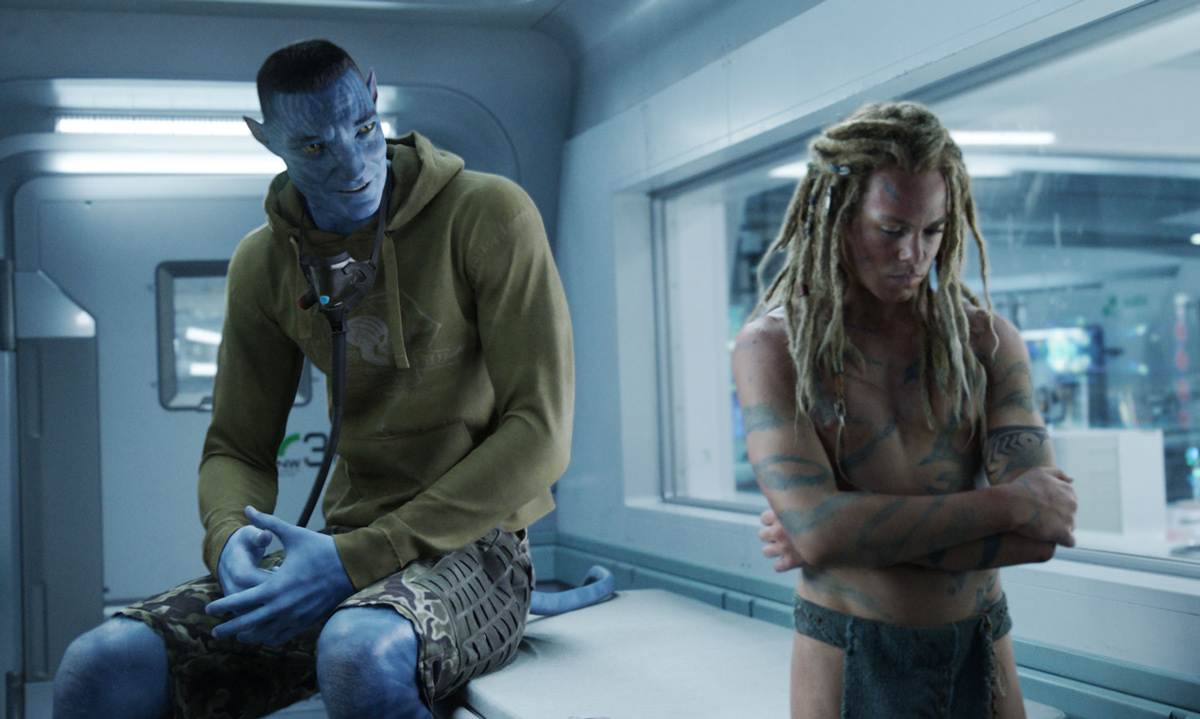
The Sullys are also still taking care of the aforementioned Spider, the gone-native son of Col Quaritch (Stephen Lang), who died in the last movie, but had his consciousness preserved in his Na’avi avatar in which he now lives full time, still plotting his revenge against the traitor Jake Sully.
“Avatar,” in modern usage, has been somewhat perverted—from a word for an incarnation of Gods on Earth into one for the profile images we use to represent our disconnected digital selves online. Avatar is a story all about this conflict, between those with a natural connection to the infinite, to the flesh and blood and Earthy (the home tree, symbiosis with nature, a God who lives in the soil of the ancestral homeland) and those with a false digital one (as represented by Giovanni Ribisi as a ruthless sickly capitalist in shirtsleeves who loves golf, and Carmela Soprano, stewarding empire in a giant mech suit). So, you know, good title.
Anyway, Spider, aside from being a chipper little Spicoli who loves loin cloths more than Ted Nugent, is a problem for the Na’avi on multiple levels. He can’t live in their world without an oxygen mask he’s constantly having to recharge, and he’s also a constant target for the Sky People, aka the Pink Skins, making him a danger to both himself and to any Na’avi who harbor him. Neytiri sees the choice between this little surf rat and her biological monkey kittens as an easy one (death to all pink skins!), but the kids love Spider, especially Kiri, who is some kind of immaculately concepted Na’avi clone of Sigourney Weaver’s character from the previous movies. Kiri is a Joan of Arc-style epileptic seer, who can’t connect with the Pandoran reef’s neural net without having seizures (even weirder than the finger thing). Neytiri and Jake Sully initially try to send Spider away, but the children object, and eventually they come to a compromise, whereby they agree to take the whole gang along to find Spider’s new home among the air tribes.
And so they join a giant floating caravan of air freight clipper ships, including a flagship vessel that’s like a Spanish galleon pulled through the sky by a blimp-like air creature, accompanied by “outrider” Na’avi, flying around the ship on dragon creatures like fighter jets. Yes, James Cameron is easily as good at this lore shit as George Lucas or Frank Herbert, and it’s fairly easy to see where he’s coming from. The nature-boy Na’avi obviously can’t have extracted energy sources to power their lifestyle, they’re still living in the age of (space)sail and (space)horse, with various fantastical creatures to convey them. Only, wouldn’t that relegate Pandora’s fauna to a class of bestial servitude? It would, if not for the Na’avi’s ponytail dick-clits, aka their “queues.” The Na’avi don’t force the beasts to serve, they mind-meld with them through their ponytails, complete with a shot that cracks me up every time, of the beasts’ irises pinholing to consummate the connection. What if you could, like, plug in to your space horse, so the two of you were, like, psychically connected, maaan? I’M JACKING IN! (*pupils pinholing*)
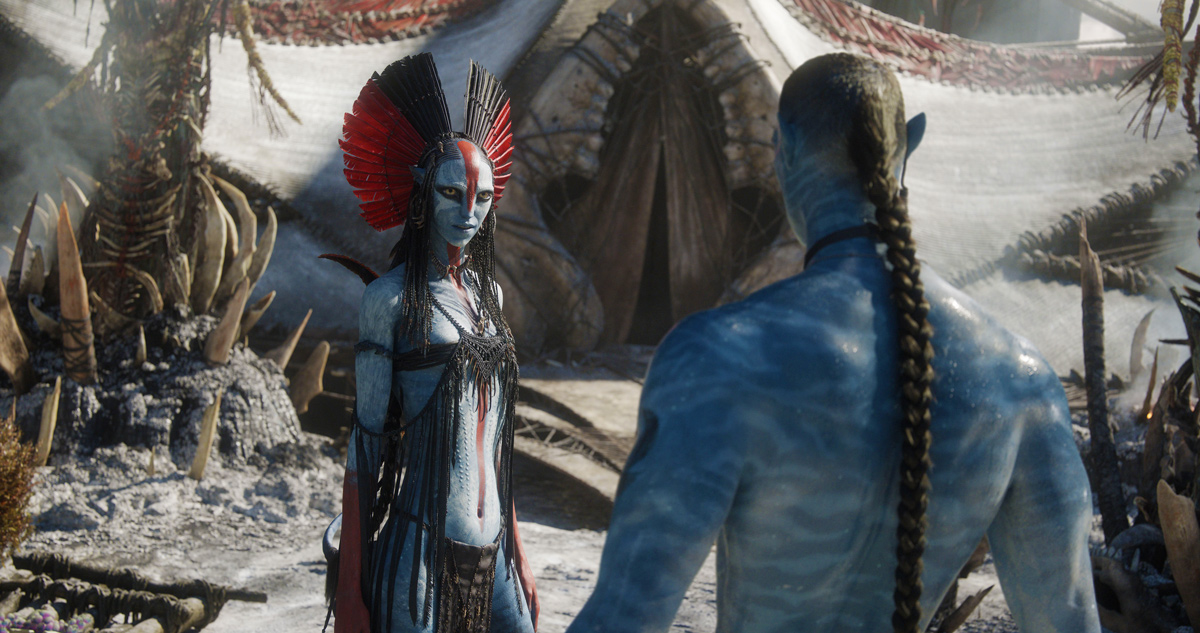
On their way to take Spider to the proverbial big farm upstate, the floating Sully caravan is attacked by the ash tribe, a gang of destructive raiders led by the psycho-sexy war priestess, Varang, played (voiced?) by Oona Chaplin. Varang is a pure nihilist, who just wants to watch the world burn (hence the ashes), and behead every man she sees while they posthumously pleasure her, Praying Mantis-style. She and Col. Quaritch get along famously from the jump, and eventually the two become partners in evil (and sex!).
Meanwhile, the Sully clan had been stockpiling Sky People guns for use in the next battle with them (much to the chagrin of the water Na’avi, who say that steel weapons corrode the soul). Varang’s Ash people promptly steal the bullet weapons order to dominate their tribal rivals, thereby setting in motion a sort of proxy war, between Quaritch, Giovanni Ribisi, and Carmela arming the Ash people on the one side, and the Na’avi having to defend themselves on multiple fronts on the other. If the first Avatar reminded people of Dances with Wolves, this one is equally reminiscent of Last of the Mohicans, with sexy Varang standing in for Wes Studi’s Magua (as far as influences go, you could do a lot worse).
You might be wondering, with the cards this stacked against them, how can the Na’avi possible avoid annihilation? To which I’d answer: uh, do you even remember the WHALES, bro??
Every water Na’avi just so happens to have a “tulkun” (those are the whales) counterpart with whom they communicate using vibrations, sign language, and telepathy. As you may remember, Lo’ak’s whale brother, Payakan, has been exiled by the other tulkuns for breaking the tulkun taboo against killing people. Which Payakan obviously only did to save his Na’avi brothers from the sky people. The whales and water Na’avi stage an entire Whale Council in order to adjudicate this matter, which ultimately correctly exonerates Whaluigi Whalangione. Free Payakan! WHALE COURT: ADJOURNED!
